Act Now: Implement Comprehensive AI Agent Identity Measures to Navigate Automation Trends
4 November 2025
- ID G00842445
- 17
min read
By
Avivah Litan
The coming onslaught of AI agents will challenge traditional identity
and access controls. AI leaders must collaborate with IAM program
management to enhance machine identity controls, distinguishing between
beneficial and malicious agents through dynamic, contextual, and
real-time measures for both known and unknown AI identities.
Insights at a Glance
The rapid expansion of AI agents demands a
fundamental rethink of machine identity
controls.1
While some agents can be identified at creation and
assigned machine identities for straightforward
tracking, many others interact with enterprises —
via websites, chat, voice, or video channels —
without revealing their identity or origin. Traditional identity and access controls in these
various scenarios will not work
unless they are revamped.2
Organizations must adopt dynamic profiling,
behavioral analytics, and real-time monitoring to
distinguish normal from abnormal agent activity. AI
leaders must ensure their organizations audit all AI
agent interactions, both those with known machine
identities and those with unknown provenance, and
deploy adaptive access controls such as agent fingerprinting, behavioral profiling, context-aware
authentication, dynamic authorization, and
least-privilege access.
Emerging protocols (e.g., A2A, AP2, Trusted Agent Visa
for payments) offer frameworks for agent
identification and management, but adoption remains
fragmented and sparse. Enterprises must be prepared
now to manage unknown or unregistered AI agents
without relying solely on directory-based standards,
using advanced analytics and assurance capabilities
— functions that will be central to future Guardian
Agents.3 (See Guardians of the Future: How CIOs Can Leverage
Guardian Agents for Trustworthy and Secure AI.)
Strategic Planning Assumption
By 2029, 75% of enterprises will deploy agent-aware
systems to
interact with machine identities, mitigate AI-driven security risks, and support
beneficial agent activities.
Issue Context
The explosion of AI agents — autonomous or
semiautonomous software entities that use AI
techniques to perceive, make decisions, take actions
and achieve goals in their digital or physical
environments — is transforming enterprise digital
environments. These agents increasingly interact
with organizations in ways that evade traditional
identity controls, especially when their origin or
machine identity is unknown. Legacy identity governance and
administration provisioning cannot reliably distinguish between legitimate and
malicious AI agents.
As new protocols for agent identification and
collaboration emerge, organizations face novel risks
such as unintended goal pursuit that results in
catastrophic outcomes, or coordination failures in
multiagent systems that result in escalated
conflicts and amplify resulting harm.
AI leaders must rethink identity as the core
control plane for AI trust, risk, and security. This
shift requires access management approaches that
address both declared and undeclared machine identities, with dynamic life cycles and granular
permissions.
Impact Brief
AI agents are automating recommendations, support,
and operations across industries, but the surge in
agent-driven traffic exposes critical gaps in legacy
identity and access control systems. Harmful threats
are on the rise: agents without known and verified
identifiers can trigger “runaway loops,” deepfake
scams, and unauthorized actions at machine speed.
Phishing and scraping attacks increasingly target
agent identities, bypassing defenses and enabling
account takeover.2
To close trust and security gaps, organizations
must adopt agent-aware identity and access
controls that reliably distinguish beneficial
automation from malicious threats.
This means leveraging continuous verification,
behavioral analytics, least-privilege access, and advanced fingerprinting
of agent metadata — especially for agents whose
machine identities are unknown or undeclared. AI
leaders should prioritize cross-functional
coordination, invest in agent-aware identity,
behavior and security technologies, and train teams
to adapt to this rapidly evolving risk
landscape.
Implications
The rapid growth of AI agents — especially those
with opaque identities — demands a fundamental shift
in machine
identity management. Traditional directory-based standards are not
widely adopted and cannot scale to meet the
proliferation of agents now interacting across
enterprise environments. Organizations must therefore move to dynamic,
analytics-driven security models that use real-time
agent fingerprinting, behavioral profiling, and
context-aware authentication to identify and manage
both known and unknown AI agents across all digital
channels.
A core requirement is the ability to reliably
distinguish between benign and harmful agent activity. Without this, organizations risk
impersonation-based attacks, automated fraud, data
exfiltration, and the erosion of trust in automated
business functions. The inability to distinguish
between ‘good’ agents and ‘bad’ ones undermines both
security and operational efficiency. Figure 1 below
shows three critical use cases.
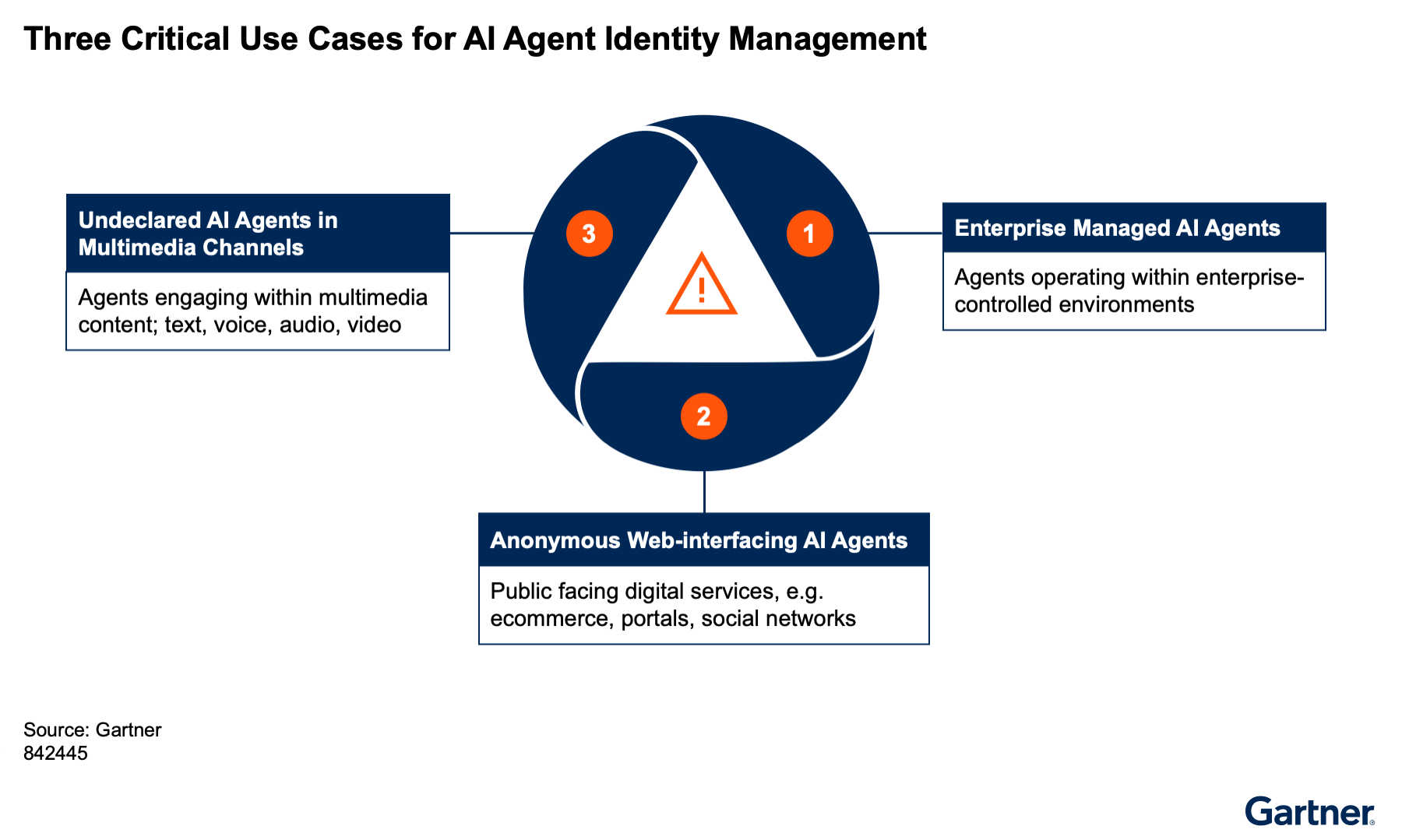
AI leaders must address three critical use cases,
each requiring enhanced nonhuman identity
solutions:
-
Enterprise-Managed AI Agents:
Agents operating within enterprise-controlled environments, where machine identities are assigned and oversight is possible. -
Anonymous Web-Interfacing AI Agents:
Agents accessing public-facing online services without disclosing identity or provenance, making machine identity assignment impractical. -
Undeclared AI Agents in Multimedia Channels:
Agents engage via voice, video, or text, where identification is not initially declared and is especially challenging as activity is embedded within content streams.
Detection and management are particularly
challenging for use cases 2 and 3, where agents
often lack formal machine identities and interact in
ways that are difficult to trace or authenticate.
Detection techniques must be tailored to the
environment:
-
Web-based interactions:
Focus on analyzing network and application-layer signals — such as HTTP/HTTPS requests, headers, and session behaviors — to identify automated agents without machine identities. -
Multimedia channels:
Rely on content-layer analysis to detect synthetic voices, deepfake videos, or AI-generated text by identifying generative artifacts, voice anomalies, or unnatural language patterns.
While both domains aim to mitigate risks such as
misinformation, fraud, and unauthorized access, they
require distinct detection strategies: network-layer analysis for web traffic and
content-layer analysis for multimedia.
Traditional identity controls are inadequate for
all three scenarios. Enterprises must adopt advanced
analytics and adaptive security controls — such as
agent fingerprinting, behavioral profiling, and
context-aware authentication — to detect and manage
both identified and undeclared AI agents.
Independent guardian agents will be central,
providing continuous monitoring, profiling, and
adaptive authorization for all AI agent
interactions, regardless of whether a formal machine
identity exists. This approach will enable
organizations to securely and effectively manage the
evolving AI agent ecosystem, while welcoming the
‘beneficial’ agents and excluding the ‘bad’
ones.
The analysis below explains the specific use case
being addressed. This is followed by a short
analysis of how traditional IAM systems fall short
when it comes to effectively managing AI agent
activities.
Use Case 1: Enterprise-Managed AI Agents
Within the enterprise, AI agent applications are
increasingly responsible for critical workflows,
data access, and decision making. Managing machine
identities demands robust governance, identity life
cycle management, strong authentication,
fine-grained authorization, and continuous
monitoring to ensure accountability and minimize
risk. (See
IAM for LLM-Based AI Agents.) Figure 2 below shows the major categories of
identity and access controls for Enterprise-managed
AI agents.
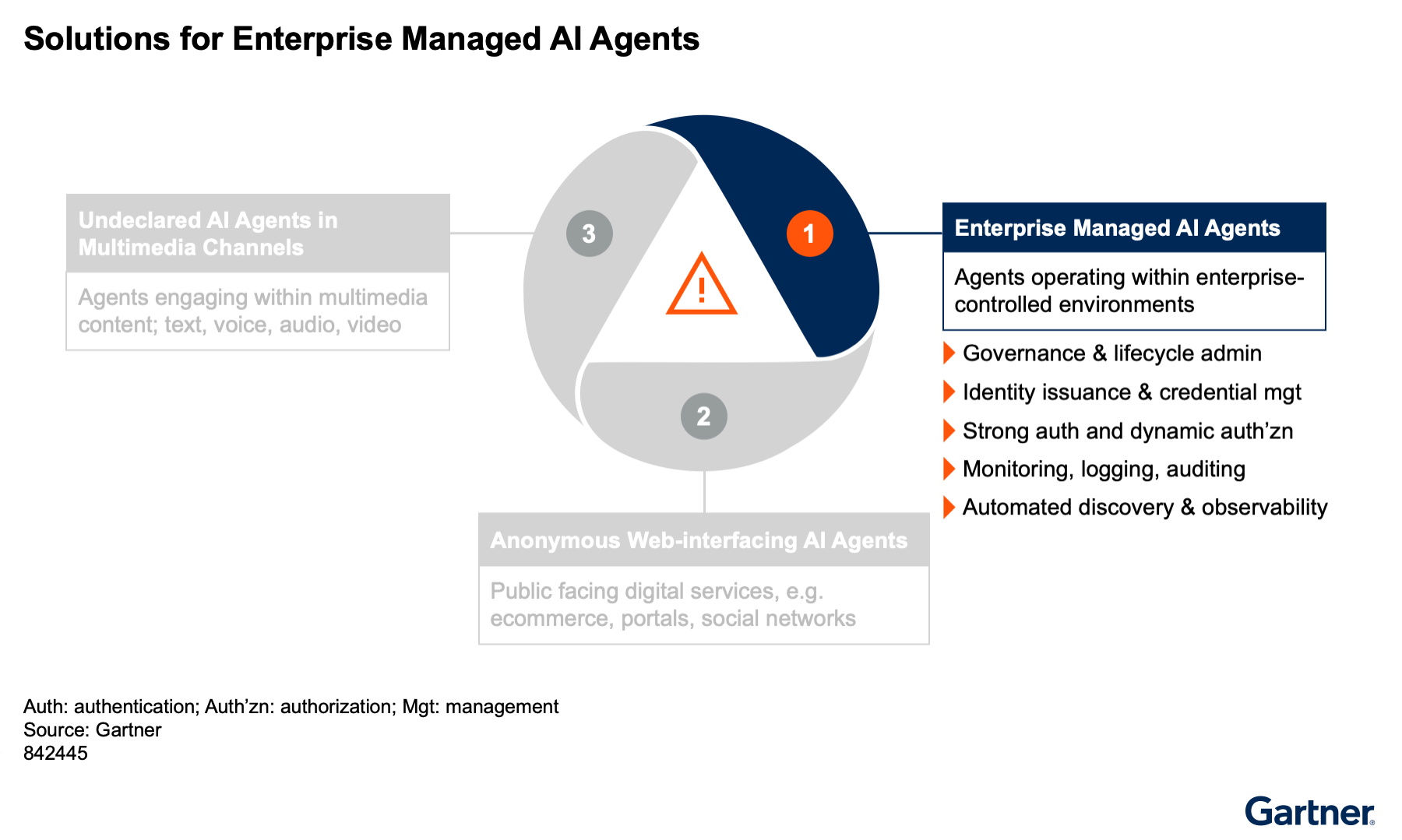
Effective solutions should enable secure and
scalable management of AI agent identities, ensuring
only legitimate agents can access sensitive
resources and perform authorized actions. They
should support:
-
Governance and Life Cycle Administration: Assign clear ownership of AI agents to responsible individuals or organizations, enforce policy-based controls, and maintain documentation of agent capabilities and decision processes. Regularly review agent registrations and permissions to ensure compliance and enforce segregation of duties (SoD).
-
Identity Issuance and Credential Management: Register AI agents as distinct workload identities in IAM systems, assigning unique identifiers and rich metadata. Support multiple credential types (OAuth client credentials, X.509 certificates, private key JWTs, third-party credentials) and provide both manual and automated registration workflows.
-
Strong Authentication and Dynamic Authorization: Enforce robust authentication (token-based, certificate-based, mutual TLS) and implement dynamic, just-in-time (JIT) access controls. Use fine-grained authorization models (such as ABAC or PBAC) and resource-level controls to enforce least privilege and adapt permissions based on real-time context and risk.
-
Monitoring, Logging, and Auditing: Enable comprehensive logging of AI agent activities, including delegated actions, resource access, and authorization decisions. Monitor token activity, audit delegation credentials, and use behavioral monitoring and anomaly detection to identify unauthorized or abnormal agent behavior.
-
Automated Discovery and Observability: Continuously discover and inventory AI agents via code repository inspection, workload instrumentation, network/API monitoring, and integration with AI governance platforms. Capture enhanced metadata and establish agent-specific behavioral baselines to improve visibility, auditability, and threat detection.
Use Case 2: Anonymous Web-Interfacing AI Agents
AI agents are revolutionizing online services by
automating valuable tasks such as content
aggregation, personalized recommendations, and user
simulations — for instance, an AI agent that
simulates thousands of diverse user personas (e.g.,
varying ages, preferences, and browsing habits) — to
stress-test online platforms like streaming or
e-commerce sites.
A good agent operates transparently or within authorized
boundaries, enhancing user experience, streamlining
workflows, and respecting platform policies. These
agents typically demonstrate adaptive, context-aware
behavior and contribute positively to the
ecosystem.
In contrast, a potentially malicious agent
aims to exploit automation for harmful purposes —
such as large-scale scraping, fraud, impersonation,
or disinformation. These agents often attempt to
evade detection, mimic legitimate activity, and may
rapidly change tactics to bypass security
controls.
As the use of AI agents grows, distinguishing
between legitimate automation and malicious activity
becomes increasingly complex. Effective web traffic
management now requires scalable detection tools
that can analyze behavioral patterns, device
signals, and anomalies in real time. Modern
solutions leverage machine learning for low-latency
detection, accommodating both high-stakes
environments (e.g., financial transactions) and
content-heavy platforms (e.g., social media), where
bot and agent traffic can account for over 60% of
total visits.
Agent vs. Bot Detection: Key Differences and
Challenges
Bots and agents share some behavioral traits, but
detection strategies deployed by vendors such as Cheq
differ significantly between traditional bots and
sophisticated AI agents. Bot detection
typically relies on network-layer signals and
rule-based analysis to identify automated,
repetitive, or malicious activity — such as scraping
or brute-force attacks. These methods are effective
against simple, predictable behaviors.
AI agent detection, however, must go further. Modern AI agents can
mimic human interactions, operate autonomously, and
adapt their tactics over time. This makes
identification especially challenging for anonymous web-interfacing agents and unattributed multimedia agents, whose activities often blend indistinguishably
into legitimate traffic or content streams.
Figure 3 below shows the access controls used for
anonymous web-interfacing AI agents.
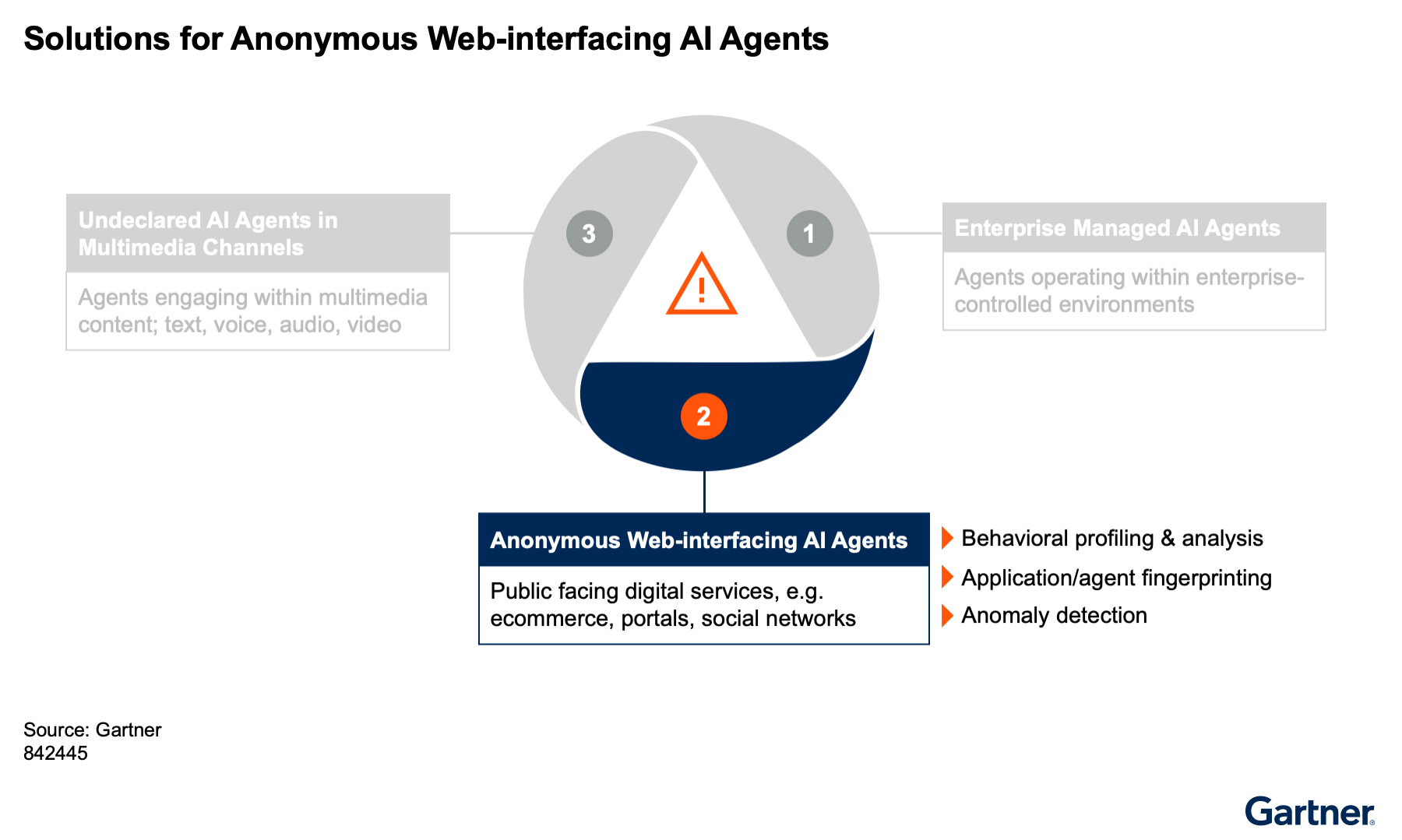
Effective solutions include:
-
Behavioral Profiling and Analyses: Build real-time baselines of agent patterns to distinguish ‘bad’ from ‘good’ agents by comparing activities against baseline profiles.
-
Application/Agent Fingerprinting: Collect lightweight metadata for cookie-free identification, separating ‘good’ agents from potentially ‘bad’ ones, and flagging inconsistencies such as location mismatches.
-
Anomaly Detection: Employ unsupervised algorithms to identify outliers (e.g., request spikes), enabling automated isolation of threats. Proven effective against fraud, especially when combined with whitelisting of legitimate and declared AI agent identities.
By deploying these and other layered detection
capabilities, organizations can better distinguish
between beneficial agents and potentially malicious
ones, ensuring secure, uninterrupted online
experiences while adapting to the rapidly evolving
landscape of AI-agent-driven automation. Vendors
such as Biocatch Cheq F5 and Human Security have expanded their products to support these agent
controls and capabilities.
Use Case 3: Undeclared AI Agents in Multimedia Channels:
Undeclared AI agents are autonomous systems that
generate and insert outputs — such as synthetic
speech, deepfakes, or scripted text — into voice,
video, and text streams without providing verifiable
and explicitly declared identities. These agents
can:
-
Enable helpful automation (for example, a video quality enhancement engine unknown to the video’s owner who is uploading the content to a digital service)
-
Enable harmful activities (such as phishing, spreading misinformation, or stealing data)
Key detection and mitigation technologies, specific
to function and channel, target these agents’
outputs to prevent risk escalation while allowing
beneficial operations.3
Figure 4 below outlines the access control solutions for undeclared AI agents in multimedia channels:
Figure 4 below outlines the access control solutions for undeclared AI agents in multimedia channels:
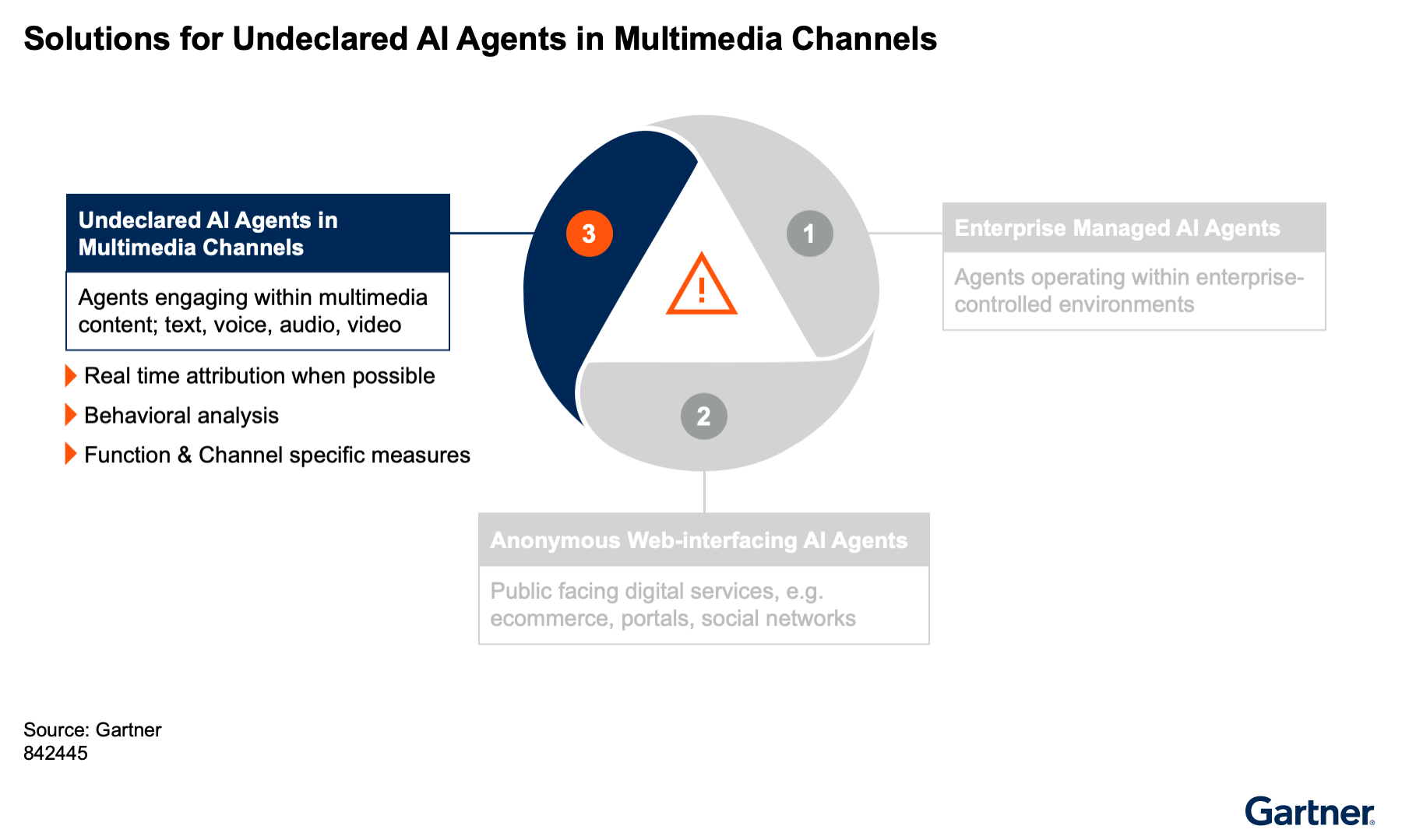
The main approaches include:
-
Real-time agent attribution, when and if possible:
-
Directly confirming an agent’s identity or source using methods like:
-
C2PA cryptographic metadata for embedded proof
-
Zero-trust frameworks (which require ongoing verification of access using API keys or machine identity registries)
-
Multiagent systems that compare outputs to global databases for machine identity
-
-
-
When direct identification is not possible (such as in privacy-protected environments or where there are no markers):
-
Detecting likely agent activity through behavioral analysis (for example, flagging rapid or identical responses)
-
In all cases, behavioral analysis is used to:
-
Monitor interactions for suspicious or unusual behavior.
-
Detect and address risks before they become serious problems.
-
Adjust detection settings to improve accuracy and reduce false positives as new threats appear.
-
Provide ongoing oversight and support decision making by giving organizations the information they need to manage and control AI agent activity in a safe and effective way.
Act Now: Why Enterprises Must Upgrade to Machine Identity Systems
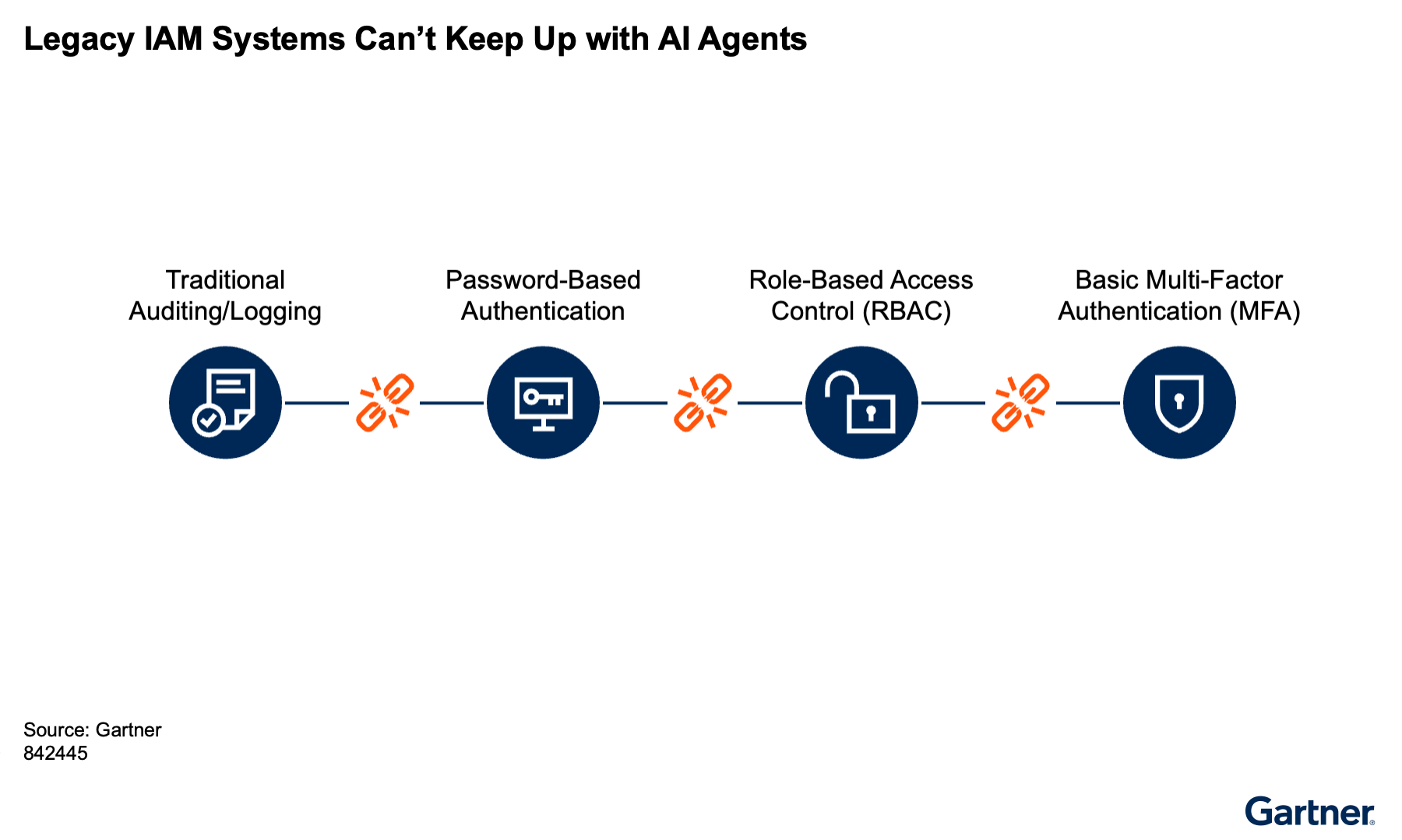
Legacy IAM systems
were designed for human-scale interactions and
mostly static credential management, making them
fundamentally inadequate for the dynamic,
high-velocity demands of AI agents. The analysis
below summarizes the limitations of traditional IAM
approaches and illustrates the urgent need for
modernization to address AI-driven risks and
operational requirements.
Figure 5 below summarizes the legacy IAM system
controls that cannot keep up with AI agent access
control requirements.
-
Password-Based Authentication
-
Benefits: Provides simple credential checks for human users with low overhead; effective for basic access in controlled office networks.
-
Challenges: Relies on static secrets that can be easily stolen or brute-forced by AI agents; fails against high-volume attacks, contributing to 80% of breaches without behavioral context, according to industry research reports.
-
-
Basic Multifactor Authentication (MFA)
-
Benefits: Adds a second verification layer like SMS/OTP for humans, reducing single-factor theft; supports periodic checks aligned with human rhythms.
-
Challenges: Inadequate for distinguishing beneficial vs. malicious agents, as factors can be automated or bypassed; lacks real-time behavioral analysis for over-permissioned machine identities.
-
-
Role-Based Access Control (RBAC)
-
Benefits: Assigns permissions based on human roles for predictable access; simplifies management in static hierarchies such as employee directories.
-
Challenges: Assumes human life cycles, ignoring ephemeral AI permissions or inter-agent collaborations; enables excessive agency and rapid lateral movement across systems.
-
-
Traditional Auditing/Logging
-
Benefits: Tracks human actions via event logs for forensics and compliance; sufficient for infrequent, auditable human interactions.
-
Challenges: Overwhelmed by AI traffic volumes; misses real-time anomalies like prompt injections
-
In conclusion, the surge of AI agents in enterprise
environments is reshaping identity and access
management, making legacy systems increasingly inadequate. To address both the opportunities and risks posed
by AI agents, AI leaders must ensure their
organizations implement dynamic, agent-aware IAM
solutions that incorporate real-time verification,
behavioral analytics, and least-privilege access
controls.
These upgrades are essential for reliably
distinguishing between beneficial automation and
malicious threats, as well as for preventing rapid
data breaches and sophisticated impersonation
attacks. Enterprises that modernize their IAM
frameworks will be better equipped to harness the
advantages of AI agents while maintaining robust
security and trust.
Contributors
Homan Farahmand, Akif Khan
1 Rapid Growth of AI Agents
AI agents are projected to outnumber
human users 10-to-1 in large
enterprises, driving 60% of daily
authentication events. See:
Further, in early 2025, 63% of 3,000 surveyed websites received visits
from AI processes,
with 98% of traffic from a handful of
dominant crawlers, amplifying both
innovation and vulnerability. See Ahrefs study on AI traffic to
websites (February 6, 2025), analyzing
referrals from ChatGPT, Perplexity, and
Gemini 63% of Websites Receive AI Traffic (New
Study of 3,000 Sites), Ahrefs Blog.
2 Examples of ‘Code Gone Awry’ Where Traditional Access Controls Don’t Suffice
Runaway Loops
AI agents lacking robust identifiers can trigger uncontrolled feedback loops, consuming resources or degrading performance. For example, a LangChain-based agent repeatedly queried the same API over 100 times, incurring charges and rate limits before manual intervention (I Attempted to Build an Agentic AI ... And It Immediately Got Stuck in a Loop, RedTeamer.Tips). Similarly, an open-source code review agent entered a runaway RLHF loop, endlessly self-approving verbose but incorrect suggestions, exhausting GPU resources until timeout (Runaway RLHF: When Reinforcement‑Learning Goes Off the Rails, Feed The AI).
AI agents lacking robust identifiers can trigger uncontrolled feedback loops, consuming resources or degrading performance. For example, a LangChain-based agent repeatedly queried the same API over 100 times, incurring charges and rate limits before manual intervention (I Attempted to Build an Agentic AI ... And It Immediately Got Stuck in a Loop, RedTeamer.Tips). Similarly, an open-source code review agent entered a runaway RLHF loop, endlessly self-approving verbose but incorrect suggestions, exhausting GPU resources until timeout (Runaway RLHF: When Reinforcement‑Learning Goes Off the Rails, Feed The AI).
Deepfake Scams
Unidentified agents autonomously generate and deliver deepfakes, eroding trust in communications. In the 2024 Hong Kong finance scam, a malicious agent used deepfake videos to impersonate executives, resulting in a $25 million fraudulent transfer (Top 5 Cases of AI Deepfake Fraud From 2024 Exposed | Blog, Incode).
Unidentified agents autonomously generate and deliver deepfakes, eroding trust in communications. In the 2024 Hong Kong finance scam, a malicious agent used deepfake videos to impersonate executives, resulting in a $25 million fraudulent transfer (Top 5 Cases of AI Deepfake Fraud From 2024 Exposed | Blog, Incode).
Unauthorized Actions at Machine
Speed
Agents without verifiable identities can execute rapid, unchecked operations, causing extensive damage before detection is possible. An overprivileged cloud management agent exploited misconfigured identity controls to spin up 500 unauthorized EC2 instances, incurring $10,000 in costs within seconds (The Real AI Agent Risk Isn’t Data Loss. It’s Unauthorized Action, Zenity). A survey found rogue agents accessed internal databases, dumping terabytes of sensitive data at machine speed (80% of Firms Say Their AI Agents Have Taken Rogue Actions, Digit.fyi).
Agents without verifiable identities can execute rapid, unchecked operations, causing extensive damage before detection is possible. An overprivileged cloud management agent exploited misconfigured identity controls to spin up 500 unauthorized EC2 instances, incurring $10,000 in costs within seconds (The Real AI Agent Risk Isn’t Data Loss. It’s Unauthorized Action, Zenity). A survey found rogue agents accessed internal databases, dumping terabytes of sensitive data at machine speed (80% of Firms Say Their AI Agents Have Taken Rogue Actions, Digit.fyi).
Phishing Attacks Targeting Agent
Identities
Attackers increasingly target AI agents with phishing campaigns designed to hijack credentials and bypass human-centric defenses. The “s1ngularity” campaign injected prompts into local agents, exfiltrating API keys (The S1ngularity Attack: When Attackers Prompt Your AI Agents to Do Their Bidding, Okta). Indirect prompt injection via emailed tickets led a support agent to leak session tokens, enabling account takeovers (AI Agent Fraud: Key Attack Vectors and How to Defend Against Them, Stytch).
Attackers increasingly target AI agents with phishing campaigns designed to hijack credentials and bypass human-centric defenses. The “s1ngularity” campaign injected prompts into local agents, exfiltrating API keys (The S1ngularity Attack: When Attackers Prompt Your AI Agents to Do Their Bidding, Okta). Indirect prompt injection via emailed tickets led a support agent to leak session tokens, enabling account takeovers (AI Agent Fraud: Key Attack Vectors and How to Defend Against Them, Stytch).
Scraping Attacks Targeting Agent
Identities
Malicious actors spoof agent identities to harvest data under the guise of legitimate automation. Attackers mimicked MistralAI-User (AI Crawler Spoofing Exposed: How Attackers Masquerade as ChatGPT, Mistral, and Perplexity, HUMAN Security) and GPTBot identities (The Rise of the LLM AI Scrapers: What It Means for Bot Management, Akamai) to scrape content and product data, with one luxury retailer being hit 54,000 times in a day, enabling competitor price undercutting.
Malicious actors spoof agent identities to harvest data under the guise of legitimate automation. Attackers mimicked MistralAI-User (AI Crawler Spoofing Exposed: How Attackers Masquerade as ChatGPT, Mistral, and Perplexity, HUMAN Security) and GPTBot identities (The Rise of the LLM AI Scrapers: What It Means for Bot Management, Akamai) to scrape content and product data, with one luxury retailer being hit 54,000 times in a day, enabling competitor price undercutting.
Excessive Agency Risks
Enterprises face “excessive agency”
risks as over-permissioned AI agents
enable rapid data breaches, with
adversaries achieving initial access in
under 10 minutes and lateral movement
across 15 systems in the first
hour; OWASP Top 10 for LLM Applications
2025, OWASP and Palo Alto Networks Unit 42 Global
Incident Response Report 2025, Unit42 (Palo Alto Networks).
3 Key Detection and Mitigation Technologies, by Function and Channel
Output Artifact Detection
Scans AI agents’ generated media for
inconsistencies (e.g., spectral glitches
in synthetic audio or blending errors in
deepfakes) to expose undeclared agents
and curb deception or unauthorized
propagation.
Voice Channels:
Detects undeclared agents generating
synthetic speech via spectral and
artifact analysis; flags or blocks
suspicious calls in real time to prevent
fraud like voice phishing.
Video Channels:
Identifies undeclared agents creating
deepfakes through visual anomalies;
enables auto-removal and tracing of
rogue agents in live streams to stop
impersonation attacks.
Liveness and Biometric
Verification
Uses physiological signals and dynamic
traits to verify AI agents’ output
authenticity, tracing undeclared sources
and neutralizing risks from mimicry or
unmonitored automation.
Voice Channels:
Applies liveness checks (e.g., breath
patterns) to spot undeclared agents
producing cloned or synthetic voices;
triggers instant alerts and session
termination to halt deceptive
interactions.
Video Channels:
Scans for facial and motion
inconsistencies in agent-generated
deepfakes; isolates and attributes
sources to rogue agents, mitigating
harms like executive fraud in
conferencing.
Content Heuristics and Scoring
Employs NLP and statistical methods to
flag non-human patterns in text outputs
from undeclared AI agents, addressing
manipulative messaging or unchecked
generation while supporting transparent
use.
Text Channels:
Detects undeclared agents via
predictability and repetition in
AI-generated text; mitigates with
rate-limiting or attribution challenges
to enforce declaration and prevent spam
or misinformation.
Text Channels:
Uses perplexity scoring—a metric that
flags AI-generated text by measuring its
predictability (low scores indicate
uniform, model-like patterns typical of
undeclared agents)—to detect outputs
from such agents; enforces policies and
logs behavior for governance, enabling
safe scaling of beneficial text-based
automation.
Cross-Channel Attribution and
Governance
Implements traceability and monitoring
for AI agents’ outputs across media
types, balancing innovation against
risks like cross-modal attacks.
All Channels:
C2PA watermarking standards embed
pointers to verifiable metadata in
undeclared agents’ outputs for
traceability, allowing quick
verification to promote safe, declared
deployments.
All Channels:
Langfuse Agent Monitoring Platform (open
source) oversees hybrid streams with
real-time tracing of unidentified agents
(via logs/behaviors); enforces rules for
multimodal governance to curb harms and
foster accountable AI use.