Overview
Impacts
-
Broadcom’s acquisition of VMware leaves
many I&O leaders facing the decision
of whether to move to an alternative.
Those who choose to do so face numerous challenges, uncertain outcomes
and tight deadlines as they work to
select a suitable alternative to VMware infrastructure, given the vast
array of available options.
Recommendations
-
Select your modernization
platform by evaluating factors such as hybrid cloud
integration, long-term viability, cloud-native compatibility and ISV ecosystem
support. While doing so, look
beyond just the acquisition cost.
-
Take stock of your skills, pain points,
optimization potential and infrastructure dependencies, as well as
the compatibility of your applications
to run on alternative platforms. Consider the migration time
constraints, as they can significantly
influence the planning and execution
phases of your strategy.
-
Choose tactical approaches when aiming
for smoother transitions, where
upskilling is easier and applications
require minimal redesign and
refactoring. Opt for familiar hardware
vendors and architectures to achieve
implementation within the next two
years.
-
Choose strategic approaches
only if you are prepared to invest in a new operational model, transform your operations and upskill
your talent pool. Consider how your
application placement strategy
influences the selection of a platform
alternative to VMware. This strategy will determine
the optimal environment for agility,
long-term viability and
cost-effectiveness.
Introduction
Broadcom’s acquisition
of VMware has disrupted the long-standing modernization perspectives of I&O
leaders regarding pricing, product, support and
partner relationships. Gartner clients are increasingly concerned about VMware’s rising prices
and potential declines in product quality and
technical and partner support.
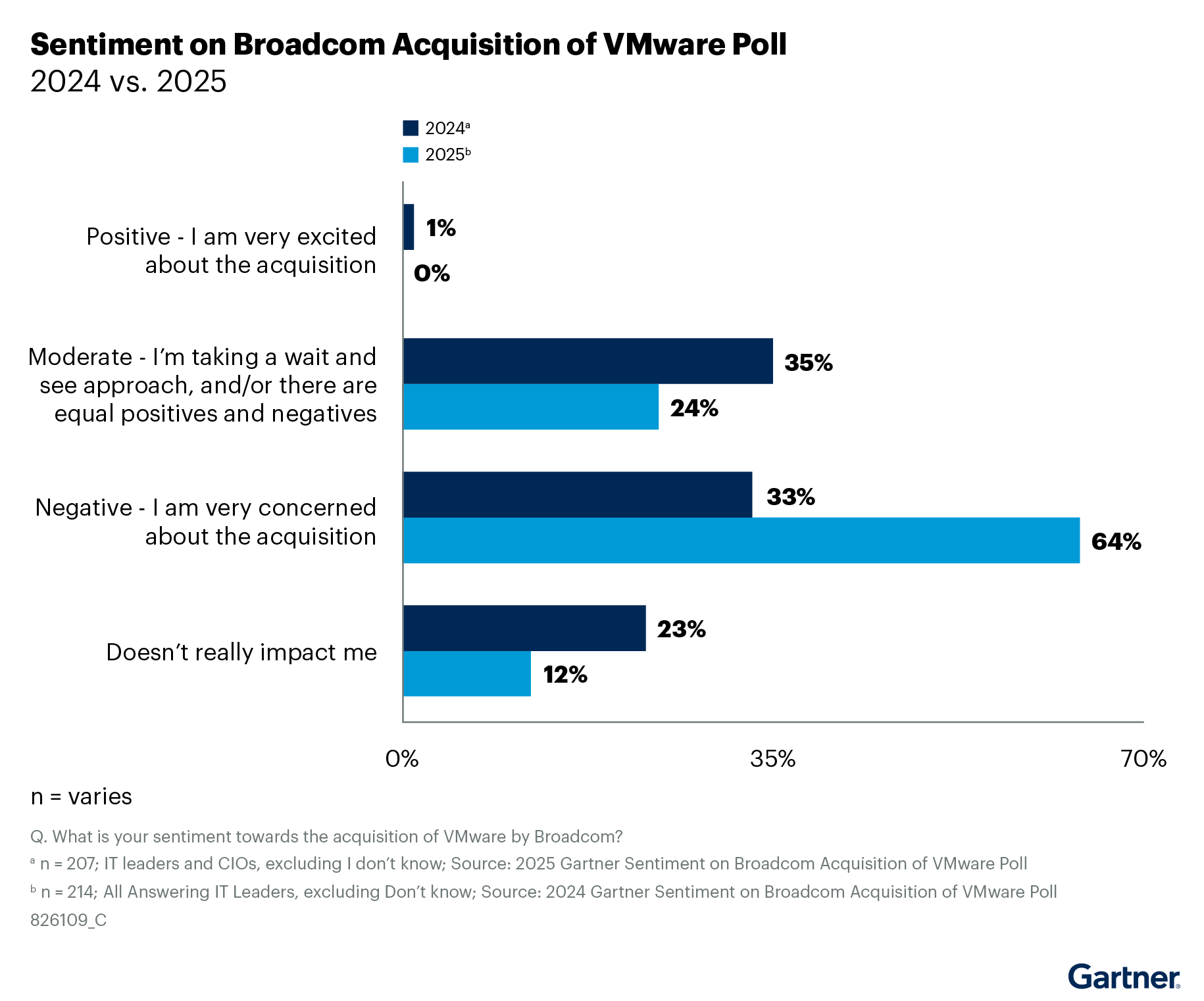
According to the 2025 Gartner Sentiment on Broadcom
Acquisition of VMware Poll (see Figure 1), a
majority of respondents (64%)
express negative feelings and serious concerns
regarding the acquisition, with none having a fully
positive outlook.1 The main reasons for this negative sentiment
include anticipated price increases, Broadcom’s
business practices and reputation, potential impacts
on innovation and product development, and changes
in licensing affecting existing contracts.
Additionally, more than half of the respondents
(52%)
report unsatisfactory experiences and are concerned
about VMware now that it is owned by Broadcom. Only 3% have had positive experiences. The primary factors contributing to these negative
experiences are price increases and issues with
communication and support. As a result, many
respondents are developing strategies to reduce or
eliminate their reliance on VMware and
Broadcom.
Figure 1: Sentiment on Broadcom
Acquisition of VMware Poll
Source: Gartner
Many organizations are actively exploring
alternative solutions to develop a “Plan B” for
infrastructure modernization, and time is a critical
factor impacting approach (strategic versus
tactical).
This exploration and ability to execute with time
constraints, which are a function of the renewal
cycle, is crucial for limiting the disruption of a
potential migration. Execution must factor in the
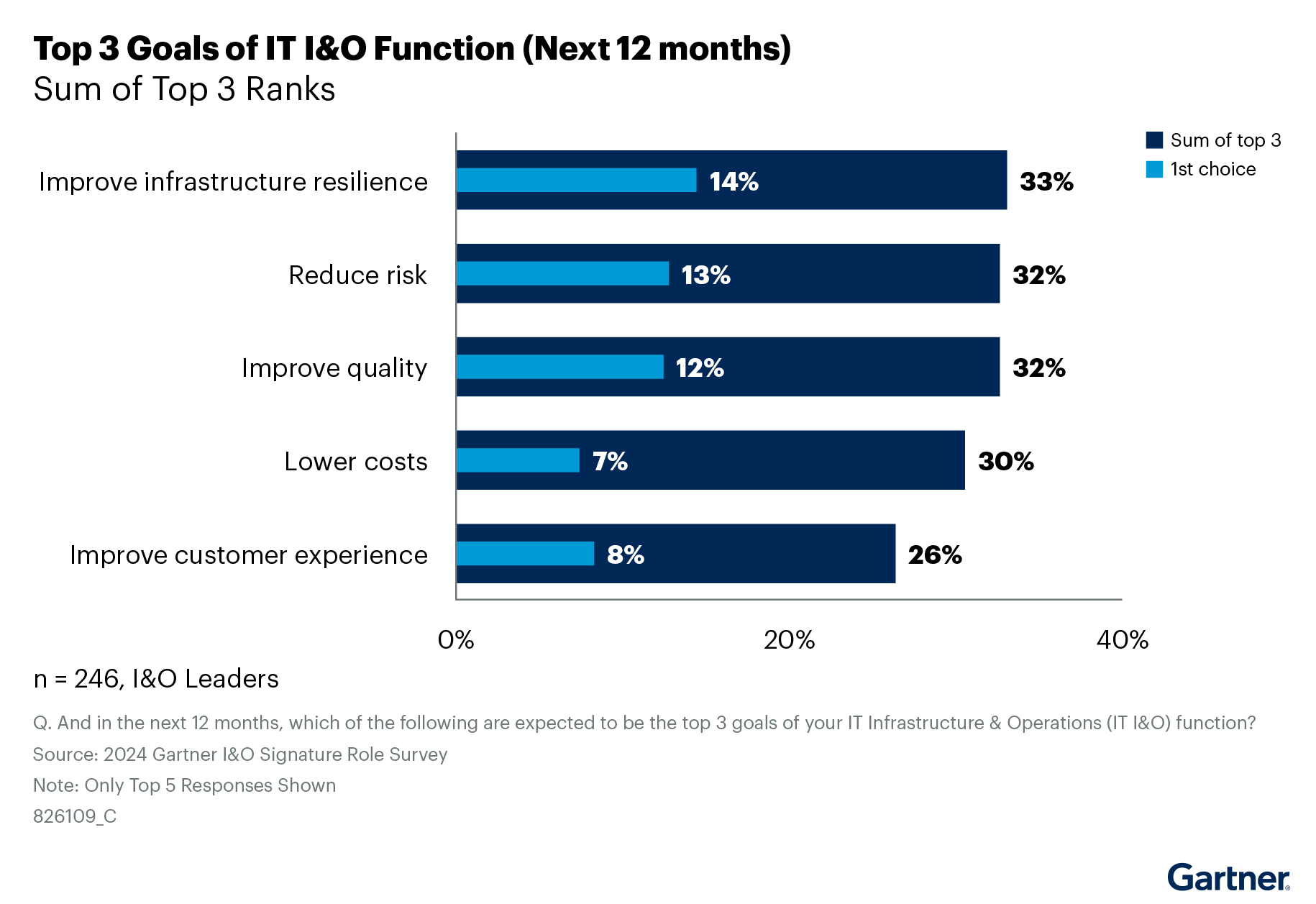
top goals of I&O. According to the 2024 Gartner
I&O Signature Role Survey, the
top goals are infrastructure resilience, quality,
risk and costs (see Figure 2).2
Figure 2: Tops 3 Goals of I&O
Function
Navigating between tactical and strategic options
for VMware replacement involves careful planning and
consideration of both immediate needs and long-term
goals. First, assess your current needs and define
long-term objectives. Consider
factors like available skills, existing talent pool
and infrastructure dependencies. When selecting
next-generation infrastructure platforms, I&O
leaders must navigate between tactical and strategic
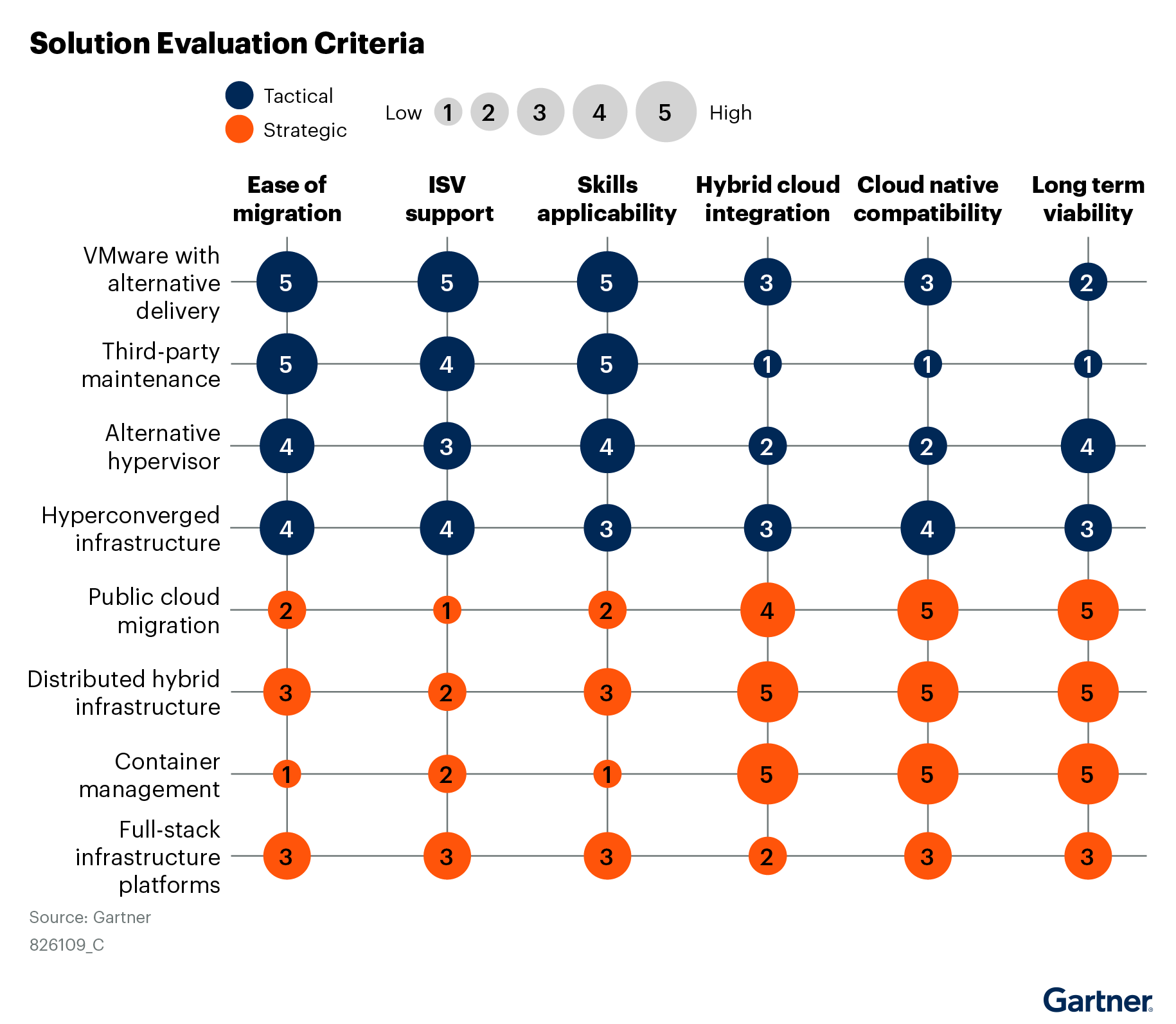
choices (see Figure 3), each evaluated based on criteria such
as ease of migration, skills applicability, hybrid
cloud integration, cloud-native compatibility and
long-term viability.
Figure 3: Tactical and Strategic
Approach to Modernization
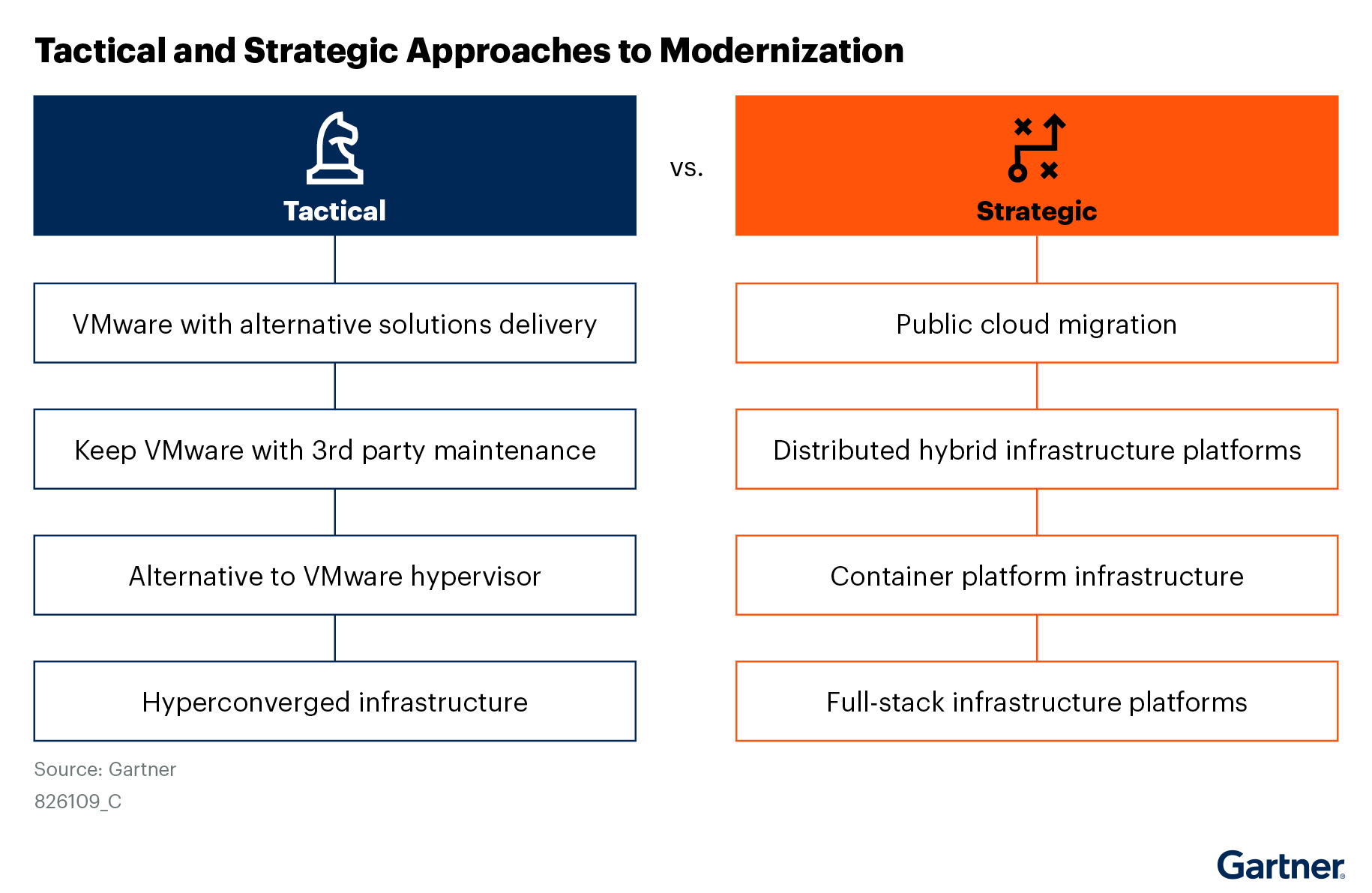
Tactical options
are immediate, short-term solutions designed to
address current needs and challenges. They focus on
quick implementation and often prioritize ease of
transition and existing skills applicability.
Tactical options may not always align with future
goals or technological advancements but are
effective for addressing pressing issues. For
instance, using VMware with alternative delivery or
third-party maintenance provides immediate migration
benefits, but this option may lack
future-focused viability or cloud-native
integration.
Strategic options
are long-term solutions aimed at aligning with
future goals and technological trends. They focus on
sustainable growth, adaptability and readiness for
emerging technologies. Strategic options often
involve more complex transitions, but are designed
to provide lasting value and integration with future
infrastructure needs. For example, lifting to the
public cloud or adopting container platforms emphasizes cloud-native readiness and
long-term viability, aligning with cloud-centric and
hybrid cloud strategies.
Impacts and Recommendations
I&O Leaders Must Rapidly Identify the Most Suitable
VMware Alternatives for Their Environment
Tactical options for selecting VMware alternatives
include VMware with alternative delivery, which offers migration and skills applicability for
immediate transitions but lacks future-focused
viability. Third-party maintenance is a good option for those looking for ease of
migration and skills transfer, but falls short in modern cloud integration and
long-term viability. An alternative hypervisor
provides a balanced approach with good migration and
skills applicability and strong long-term viability,
though its cloud integration is moderate. Hyperconverged infrastructure
stands out for its robust integration capabilities
and adaptability for immediate needs.
On the strategic side, lift to the public cloud offers cloud integration and long-term viability, making
it ideal for cloud-centric strategies, despite some
possible migration challenges. Distributed hybrid infrastructure (DHI) and container platforms
lead in cloud-native readiness, offering
future-ready solutions for organizations embracing
hybrid cloud approaches. Full-stack infrastructure platforms
offer the advantage of single vendor support,
providing balanced versatility to meet a wide range
of strategic needs while also ensuring unified
management. The optimal strategy to tackle strategic
objectives is to modernize applications, making them
more cloud native, though this transition poses significant
difficulties.
Ultimately, organizations must align their
infrastructure choice with their specific
requirements and long-term goals to ensure strategic
alignment and technological success (see Figure 4
below).
Figure 4: Solution Evaluation
Criteria
Additionally, the estimated migration time is primarily influenced
by the complexity of the application stack, the
extent of VMware deployment, the size of deployments
and the resources available.
I&O leaders should expect the migration process
to take up to two years for options scoring between four and five on the “ease of migration” rubric in the
figure above, and up to four years for alternatives
scoring between one and three.
Tactical Approaches
VMware With Alternative Delivery
What is this alternative?
Consider alternatives for infrastructure delivery
and operations based on the VMware platform such
as:
-
Delivery of VMware solutions by a VMware
service provider
-
Migration of VMware solutions to a
platform-native consumption service (PNCS)
vendor
-
Moving VMware deployment to hyperscale
cloud providers
Why do customers select this option?
-
To eliminate
the need to migrate from their existing
platform.
-
Due to the potential abstraction from Broadcom price
negotiations
and support and services.
-
Due to the ease of hardware and software
integration and support.
-
To lower
dependencies on hardware investment and
selection
if using hosted or as-a-service delivery
options.
-
To remove CapEx acquisition patterns,
introducing shorter-term commitments and
switching to as-a-service delivery.
Sample vendors and products:
-
VMware cloud service providers (VCSP)
-
PNCS vendors: Dell APEX, HPE GreenLake, Lenovo
TruScale
-
Hyperscale cloud providers: Microsoft Azure VMware Solution, Amazon Elastic VMware Service (EVS), Google
Cloud VMware Engine, Oracle Cloud VMware
Solution, IBM Cloud for VMware
Solutions
Key considerations:
-
Analyze the alternatives based on the
provider’s ability to deliver VMware through
hosted private cloud, managed private cloud,
sovereign cloud or public cloud.
-
Select a VCSP Pinnacle Partner that can show total cost of ownership (TCO)
advantages and offers differentiating
value-add services versus existing modus
operandi for you.
-
Evaluate the vendor’s ability to provide
existing license portability and
comprehensive migration services. As part of
the migration process, take advantage of the
vendor capabilities to optimize VMware
deployments for improved efficiency. Reduce core count by rightsizing virtual
machines and scrutinizing resource
requirements based on utilization
numbers.
-
Consider the international
availability
of VMware cloud service providers, as some
offer global support while others may be
focused more on a specific region.
-
Note that customers often avoid this option
because it doesn’t eliminate their reliance
on VMware, and some prefer CapEx
pricing. Additionally, the cost is
frequently much higher compared to CapEx or
perpetual pricing models.
Additional resources:
Third-Party Maintenance
What is this alternative?
Third-party support suppliers for VMware are capable
of providing services such as maintenance, technical
support and consulting for VMware products and
environments. These suppliers can offer an
alternative to VMware’s own support services, often
at a reduced cost or with additional
flexibility
Why do customers select this option?
-
Customers often choose third-party
maintenance for VMware primarily due to cost
savings, as these services are usually more
affordable. They also allow end users to
keep their perpetual license.
-
Third-party providers can also offer
extended support for older VMware versions,
as well as support for existing hardware.
This allows businesses to continue using
legacy systems beyond VMware’s end-of-life
dates.
-
Choosing third-party maintenance gives
organizations the time needed to explore
strategic decisions. This approach allows
businesses to focus their internal resources
on core activities and strategic
initiatives, helping them avoid rushed
decisions about transitioning to alternative
platforms.
Sample vendors and products:
Key considerations:
-
Note that third-party support comes with inherent risk
as they cannot provide security updates.
They will only help you to mitigate any
vulnerabilities that arise. Depending on Broadcom’s goodwill to deliver
security patches for versions that have
reached end-of-life is risky.
-
Keep in mind that third-party providers
will not have access to the latest updates,
patches or new features released by VMware. This can lead to potential security
vulnerabilities or compatibility
issues.
-
Assess the history of VMware’s upgrades,
fixes and patches to determine the risks
your business might face if you choose to
operate without access to VMware’s software
updates and maintenance.
-
Ensure the third-party maintenance provider
for VMware has proven expertise and a strong
track record, validated by certifications
and customer testimonials.
-
Carefully review the service-level
agreements to confirm they meet your
business needs, focusing on response and
resolution times. Also, assess the
provider’s ability to offer customized
support to your specific environment.
-
Consider using third-party maintenance as a
temporary solution for up to 24 months while
you develop a long-term alternative to
VMware.
Additional resources:
Alternative Hypervisor Replacements
What is this alternative?
Why do customers select this option?
-
They are looking for an acceptable
replacement specifically for ESXi.
-
They want to support a three-tier
environment (for example, external SAN or
NAS storage).
-
They have made significant investment in their existing
hardware stack that
is neither due for refresh nor at the end of
its life cycle.
-
They have experience with a specific
hypervisor alternative or have the skills to
manage self-support if open-source
hypervisors are selected.
Sample vendors and products:
-
Xen, KVM, LXD
-
Microsoft Hyper-V, Vates XCP-ng, Proxmox
Virtual Environment (VE), Virtuozzo Hybrid Server,
Huawei FusionCompute, Citrix XenServer,
Oracle Linux Virtualization Manager
Key considerations:
-
Outline software compatibility requirements
and interdependencies for hypervisors being
considered.
-
Consider the skills requirements and
related costs for any alternative hypervisor
and whether training or hiring will be
needed to acquire those skills.
-
Assess support requirements and determine
whether or not a given hypervisor
alternative has the required support
capabilities.
-
Compare the management tools that are
available for hypervisor alternatives.
-
Examine the migration implications and the
tools that are available for potential
hypervisor options.
-
Consider the migration path. Many of these
alternatives have no migration tools at all.
Those that do are subpar compared to VMware vCenter Converter
or Nutanix Move.
Additional resources:
Hyperconverged Infrastructure (HCI)
What is this alternative?
HCI provides a full stack of software-defined
infrastructure that includes virtualized compute,
storage and networking from a single instantiation
designed to run on-premises.
Why do customers select this option?
-
I&O leaders exploring a different
hypervisor and facing end-of-life
infrastructure are seeking to implement an
integrated hardware and software solution
with unified management capabilities.
-
HCI is currently deployed within the
technology ecosystems supporting specific
workloads. Scaling existing HCI solutions up
and out and migrating workloads to a unified
platform accelerates migrations and
eliminates the need to reskill.
-
HCI can provide all the resources
(e.g.,
compute and storage) required to run a small-scale, highly
centralized environment and support a myriad
of edge use cases. Migration tools native to
many HCI or data protection products (e.g.,
Veeam and Commvault) simplify migration
efforts.
Sample vendors and products:
-
Arcfra Enterprise Cloud Platform (AECP),
Nutanix Cloud Infrastructure (NCI), Sangfor
HCI, Scale Computing HyperCore (HC),
StorMagic SvHCI, StarWind HCI
Appliance
Key considerations:
-
HCI products closely mirror the VMware
stack, which eases upskilling, cultural
resistance, deployment and migration
efforts.
-
Integrations with cloud and data protection
providers vary across the products and
vendors in the HCI market, requiring vetting
based on your technology ecosystem.
-
Compared to VMware product bundles such as
VCF, HCI alternatives will not have a
comparable feature set or the same set of
robust capabilities and add-ons.
-
Most HCI solutions do not support external
storage, a feature that many I&O leaders
depend on to ensure efficiency and
performance for their most critical
workloads.
-
Replicating a large-scale VMware deployment
with a like-for-like HCI environment will be
expensive and costly.
Additional resources:
Strategic Approach
Public Cloud Migration
What is this alternative?
-
Lift-and-shift cloud migration:
Rehost workloads with as few changes as
possible, treating public cloud IaaS as
“rented virtualization.”
-
Lift-and-optimize cloud migration: Migrate with a PaaS-first approach, making
few — if any — application code changes, but
rethinking I&O to take advantage of
cloud-native automation capabilities.
Why do customers select this option?
-
Customers lift-and-shift when they want a
rapid, relatively low-effort data center
exit, and do not want or need to drive
I&O transformation. A lift-and-shift
migration can potentially improve the
quality of infrastructure delivery, and may
serve as a catalyst for reducing technical
debt.
-
Customers lift-and-optimize when they seek
to reduce TCO or improve agility, accelerate
business outcomes or enable access to cloud
innovations. To be fully effective, this
approach requires transforming operations,
often with the assistance of a cloud managed
service provider (MSP).
Sample vendors and products:
-
Public cloud integrated IaaS and PaaS
providers: Amazon Web Services (AWS), Microsoft Azure,
Google Cloud, Oracle Cloud Infrastructure
(OCI)
-
Cloud MSPs:
Accenture, Deloitte, Insight, Presidio
Key considerations:
-
Historically, lift-and-shift cloud
migrations have not yielded TCO reduction
because renting infrastructure has been more
expensive than buying it. However,
Broadcom’s licensing changes may raise
on-premises TCO sufficiently to make a
lift-and-shift financially attractive.
Nevertheless, cloud optimizing during the
migration is preferable to a two-phase
migration. This type of migration is
vulnerable to becoming a “lift-and-forget”
if there is no executive commitment to
immediately funding the second phase.
-
Successful cloud migrations require new
mindsets, skills and ways of working. New
operational processes and tools are vital,
and organizations must adopt an appropriate
cloud operating model.
Additional resources:
Distributed Hybrid Infrastructure
What is this alternative?
Gartner defines distributed hybrid infrastructure
(DHI) as offerings that deliver cloud-native attributes that
can be deployed and operated where the customer
prefers — on-premises, at the edge or in the public
cloud. DHI establishes the infrastructure framework
for deploying applications across distributed
environments, while adhering to a cloud-centric
approach. This enhances agility and flexibility for
workloads beyond the confines of the public cloud
infrastructure
Why do customers select this option?
-
To implement a cloud IaaS solution (with or
without PaaS) that includes compute —
whether based on virtual machines, bare
metal or containers — storage and network
services.
-
To enable the deployment of standardized
infrastructure platforms for any deployment
scenario.
-
To effectively manage infrastructure
whether it is on-premises, in the public
cloud or at the edge.
Sample vendors and products:
-
Nutanix Cloud Platform, Microsoft Azure
Local, AWS Outposts, Oracle Compute
Cloud@Customer, Alibaba Cloud’s DHI, HUAWEI CLOUD Stack Online (HCS Online), Tencent Cloud DHI, Google Distributed Cloud
Key considerations:
-
Consider planned public cloud provider
choices and align with hybrid cloud use-case
requirements.
-
Expose migration and refactoring costs
relative to the specific DHI options that
are being considered.
-
Outline business continuity requirements
and business impact
analysis results and determine whether a
given DHI solution can meet those needs.
Verify your DHI product dependencies on
cloud connectivity and their ability to run
air-gapped.
-
Examine potential multicloud management
needs and which DHI options support
multicloud implementation.
-
Compare licensing commitments and
purchasing options that align with your
organization’s capital-expenditure or
operational-expenditure requirements.
Additional resources:
Container Management
What is this alternative?
Container orchestration platforms
are solutions that automate the deployment,
management, scaling and networking of containers,
ensuring efficient operation and communication
across distributed systems.
Why do customers select this option?
-
Container deployments offer significant
flexibility and portability, allowing
applications to run across various
environments, including on-premises, hybrid
and multicloud infrastructures.
-
Initially, containers were primarily
utilized for developing new applications
using a microservices architecture and
enhancing the life cycle management of
traditional monolithic applications. Today,
their use has expanded to include delivering
commercial off-the-shelf (COTS) software and
running data science applications, such as
analytics and machine learning (ML).
-
Managing VMs and containers within your
environment can be challenging, but the
KubeVirt project offers a promising industry
solution. As a cloud-native computing
foundation (CNCF) initiative, KubeVirt
leverages Kubernetes to manage virtual
machines alongside containers. While the project is not yet mature enough for
production use, it offers a glimpse into the future of
application hosting, where the strengths of
VMs and containers can be integrated and
managed in a unified manner.
Sample vendors and products:
Key considerations:
-
Determine whether it is a priority for the
infrastructure hosting the new application
to support cloud-native attributes such as
modularity, programmability, elasticity and
portability.
-
Verify if the vendor supports deployment
within container environments for commercial
off-the-shelf (COTS) products you intend to
virtualize.
-
Keep in mind that containers not only alter the technology
stack but also transform the collaboration
dynamics among I&O, applications, site
reliability engineering (SRE) and security teams. Adopting containers
necessitates that IT organizations undergo a
cultural shift while also creating new
workflows.
-
Focus on the most impactful initiatives,
like application modernization, as key goals
for containerization. Begin with a small
proof of concept (POC) project to build
familiarity with containers before deploying
them for more critical applications.
-
Exercise caution when migrating production
VMware virtual machines to KubeVirt,
considering potential support and
compatibility issues. These can impact the
performance and stability of your workloads
in the new environment.
Additional resources:
Full-Stack Infrastructure Platforms
What is this alternative?
A full-stack infrastructure platform is a solution
that combines compute, storage, networking and
software components, along with management and
orchestration tools, to provide a unified
environment for on-premises deployments.
Why do customers select this option?
-
I&O leaders often choose full-stack
platforms due to their comprehensive
integration capabilities. These solutions
provide an end-to-end approach, covering all
layers of the infrastructure stack, which
reduces the complexity of managing multiple
vendors and systems.
-
Some providers of full-stack infrastructure
software have enhanced their management tools to include
network infrastructure, resulting in more comprehensive software
solutions.
-
Most full-stack infrastructure platforms
offer flexible consumption business
models.
Sample vendors and products:
-
HPE VM Essentials, OpenStack, Oxide Computer Company, Platform9, Rackspace
Technology, SoftIron, Virtuozzo,
Zadara
Key considerations:
-
Full-stack infrastructure platforms differ
significantly and should be assessed
individually based on their unique
merits.
-
The deployment strategies of full-stack
infrastructure platforms also vary, focusing on different use cases, from
distributed hybrid infrastructure to private
cloud environments.
-
These providers differ based on their
geographic presence, purchasing options and
long-term viability.
-
When considering full-stack infrastructure
options, it’s important to evaluate whether
the solution is fully managed by the vendor or requires
self-management and self-support. Fully managed solutions can simplify
operations by offloading maintenance and
support to the vendor, while self-managed
and self-supported options offer greater
control but demand more internal resources
for upkeep and troubleshooting. Deciding
between these approaches depends on your
organization’s capacity for management and
support, as well as your preference for
control versus convenience.
Additional resources:
Recommendations
-
Evaluate additional value factors beyond
the acquisition cost and
migration complexity when selecting a new modernization platform. Consider elements such as hybrid cloud
integration, long-term viability and
cloud-native compatibility.
These factors can provide significant
benefits in terms of flexibility,
scalability and future-proofing your
infrastructure. Looking beyond purchase
price will ensure that the platform chosen
will support your organization’s evolving
needs and strategic goals.
-
Conduct a thorough assessment of your
current infrastructure environment and take
stock of your existing skills, pain points
and optimization potential. Additionally,
evaluate your infrastructure dependencies
and ensure that your applications are
compatible with alternative platforms. This
comprehensive assessment will help you
identify areas for improvement and ensure a
smooth transition to new systems or
processes without leaving behind the
significant technical debt.
-
Consider adopting alternative platforms of
strategic importance only if you are
prepared to embrace a new operational
model. This will likely require transforming
operations and investing in upskilling your talent pool to meet the demands of the
new platform. Without these investments, the
project is likely to fail. By preparing
your team and processes for these
changes, you can maximize the benefits of the
new platform and ensure a successful
transition that aligns with your long-term
strategic objectives.
1 2025 Gartner Sentiment on Broadcom
Acquisition of VMware Poll. This poll was conducted online from 28
January through 10 February 2025 to
understand IT leaders’ and CIOs’
sentiments about Broadcom’s acquisition
of VMware and their experience with
VMware now that it is owned by Broadcom.
In total, 212 IT leaders and CIOs who
were members of Gartner’s Research
Circle, a Gartner-managed panel,
participated. Participants were from
North America (n = 105), EMEA (n = 76),
Asia/Pacific (n = 17) and Latin America
(n = 14). Disclaimer: The results of
this poll do not represent global
findings or the market as a whole, but
reflect the sentiments of the
respondents and companies polled.
2 2024 Gartner I&O Signature Role
Survey. This survey was conducted to understand
the key goals and challenges of I&O
leaders. It also sought to explore their
budget pressures, prioritization of
technical debt and their generative AI
investments. The research was conducted
online from 15 April through 6 June
2024. In total, 246 respondents were
surveyed across the U.S. (n = 85), India
(n = 58), the U.K. (n = 54) and Germany
(n = 49). Qualifying organizations
operated in multiple industries and
reported enterprisewide revenue for
fiscal 2023 of at least $50 million or
equivalent. Qualified participants
belonged to the functional areas of
executive leadership and infrastructure
and operations. All respondents led,
participated or influenced strategies
and investment decisions for
infrastructure and operations.
Disclaimer: The results of this survey
do not represent global findings or the
market as a whole, but reflect the
sentiments of the respondents and
companies surveyed.
