Market Guide for AI Assistants for Infrastructure as Code
27 March 2026
- ID G00850450
- 10
min read
By
Hassan Ennaciri,
Daniel Betts,
As organizations scale cloud-native environments, they often struggle
with the complexity of maintaining secure, cost-effective, and
well-architected infrastructure. Heads of I&O must invest in AI
assistants for infrastructure as code to accelerate the generation of
optimized configurations, enforce policy-as-code guardrails, and ensure
that infrastructure remains compliant throughout the development life
cycle.
Overview
Key Findings
-
Advancing infrastructure as code (IaC) maturity is increasingly difficult due to the rising complexity of cloud-native environments and a persistent shortage of specialized IaC skills. General-purpose LLMs often generate code that lacks specific platform context and organizational guardrails, making it difficult to review, thereby increasing technical debt and the risk of “hallucinated” configurations.
-
Standard IaC approaches frequently overlook “Day 2” requirements, such as automated drift management and cost-aware provisioning, requiring manual postdeployment action.
-
While AI assistants provide immediate value, limiting AI to basic chat interfaces misses the long-term potential of agentic workflows. The market is shifting toward systems capable of independent planning and goal fulfillment, moving beyond reactive conversation to proactive infrastructure management.
Recommendations
-
Accelerate IaC maturity by deploying AI assistants that simplify complex cloud-native schemas and bridge the skills gap by streamlining the generation of enterprise-grade infrastructure configurations.
-
Streamline Day 2 operations by integrating AI-driven cost-aware provisioning and automated drift management to proactively minimize manual postdeployment interventions and resource waste.
-
Evolve the traditional ‘hands-on-keyboard’ workforce, including platform engineers, SREs, and cloud architects into AI-augmented orchestrators. Their mandate shifts from procedural scripting to architecting guardrails, managing AI-driven workflows, and governing AI-generated outputs.
Strategic Planning Assumptions
By 2029, 90% of I&O organizations will have
integrated context-aware AI assistants into their
IaC workflows to bridge specialized cloud-native
skill shortages compared to 5% in 2026.
By 2029, 70% of enterprises will deploy agentic AI for
automated IaC generation and drift remediation as a
core part of IT infrastructure operations, compared
to less than 1% in 2026.
Market Definition
Gartner defines AI assistants for IaC as tools
using LLMs, cloud, and other platform schemas to
generate, analyze, and optimize configurations and
deployment scripts. These solutions maintain deep
contextual and live awareness of state,
dependencies, organizational guardrails, and “Day 2”
operational requirements. They integrate into IDEs
and CI/CD workflows and provide features like
policy-as-code enforcement, cost-aware provisioning,
and automated drift remediation. AI assistants for
IaC are increasingly being integrated into core
infrastructure automation, DevOps, and AI SRE
platforms.
AI assistants for infrastructure as code reduce the
growing complexity and cognitive load associated
with managing hybrid IT environments and
dependencies. They currently accelerate the
provisioning of infrastructure by translating
natural language intent into executable code (such
as OpenTofu, Pulumi, Terraform, Ansible, or Kubernetes manifests), allowing teams
to adopt best practices without requiring deep understanding of domain-specific languages. These tools aim to minimize security risks by
establishing correct configurations and ensuring
compliance adherence in the infrastructure
development cycle. They enhance operational
resilience by being able to discover and explain
complex configurations and automating documentation
and IaC code creation, enabling faster onboarding
and more consistent cloud environments.
Mandatory Features
-
Generation of valid IaC syntax (e.g., HCL, YAML, JSON) from natural language descriptions for major cloud providers and platforms
-
Context-aware code completion that understands cloud resource properties, dependency relationships, and organizational standards
-
Explanation capabilities to discover, summarize, and document existing infrastructure configuration files
-
Support for standard IaC frameworks (such as Terraform, OpenTofu, Ansible, Azure Resource Manager (ARM), AWS CloudFormation, or Kubernetes manifests)
-
Infrastructure drift detection and remediation: Analysis of differences between defined code and actual runtime state with remediation suggestions
-
Shift-left policy enforcements, with the assistant flagging security vulnerabilities as the code is being typed, before it ever reaches a peer review.
Optional Features
-
Automated validation: Generation of accompanying tests to verify the generated code before it reaches the peer-review stage
-
Policy and security scanning: Automated generation of policy-as-code and detection/assessment/remediation of vulnerabilities or misconfigurations
-
IaC scaffolding: Automated generation of standardized project structures, repository skeletons, and “Golden Path” templates
-
Cost estimation: Real-time analysis of generated code to predict cloud costs and suggest cost-optimized alternatives where necessary
-
Code translation: Ability to convert infrastructure definitions from one format to another (e.g., one cloud provider definition language to another)
-
Discovery and documentation of brownfield infrastructure: Generation of IaC code from an existing environment to codify the resources used, and to address gaps
-
CLI integration: Command-line assistance for executing deployment commands, querying state, and debugging build logs
-
Fine-tuning: Ability to train or fine-tune models on private enterprise architecture patterns and module libraries
-
Visual-to-code: Generation of IaC code from architecture diagrams or whiteboard sketches
-
Self-hosting: Options for on-premises or virtual private cloud (VPC)-hosted models to ensure that infrastructure topology data remains secure
Market Description
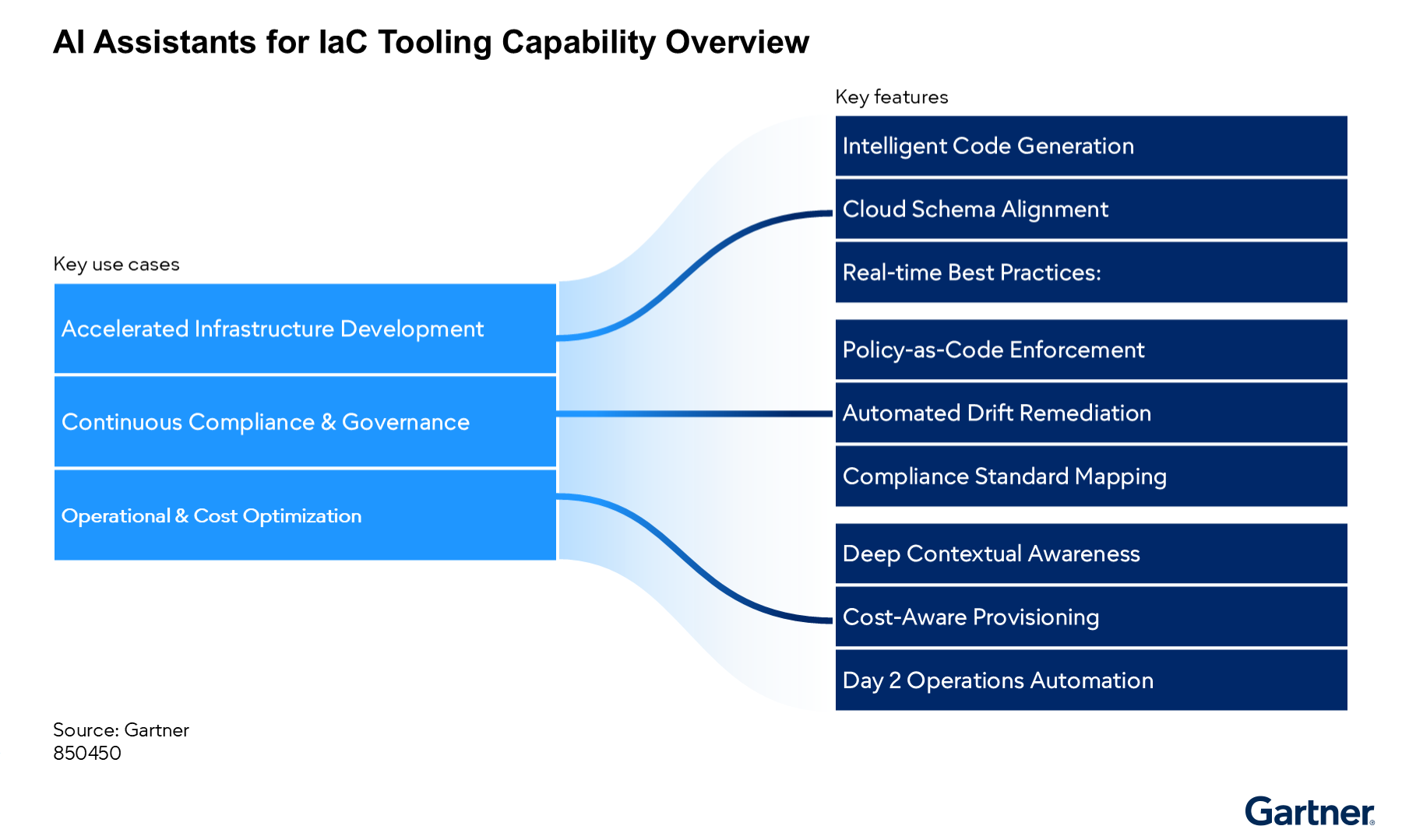
AI assistants for IaC provide context-aware
intelligence throughout the infrastructure life
cycle, enhancing the orchestration process by
integrating LLMs directly into existing automation
workflows. They act as a collaborative intelligence
layer that assists in the real-time generation,
validation, and optimization of deployment scripts,
ensuring configurations are both policy-compliant
and performant. By analyzing cloud-state data and
established best practices, these assistants provide
proactive analysis, automated drift detection,
guided remediation, and predictive recommendations
for cost-aware provisioning. This ensures that
infrastructure deployments consistently align with
corporate guardrails, security policies,
and industry well-architected frameworks (see Figure 1).
Market Direction
The market for AI assistants for infrastructure as
code (IaC) is driven by the need to modernize the
provisioning of cloud and cloud-native
infrastructure and bridge the IaC skills gap.
Traditional IaC methods are disconnected from live
operational contexts, resulting in human error,
security risks, and costly configuration
drift.
By integrating AI orchestration layers directly
into infrastructure automation and delivery
workflows, heads of I&O can evolve their teams
from primarily static scripting and authoring to
intent-based provisioning. These assistants ground
generative AI in real-time cloud telemetry and
organizational guardrails, ensuring deployments are
secure, cost-optimized, and “well-architected” from
the start.
In addition to improving the delivery capabilities,
AI IaC assistants enable organizations to reduce
cognitive load on engineers while providing
automation, infrastructure platform engineering
(IPE) and site reliability engineering (SRE) teams
with the proactive visibility needed to eliminate
“Day 2” remediation hurdles. As hybrid and
multicloud complexity scales, AI-driven IaC is an
essential investment for maintaining delivery
velocity and fiscal responsibility.
Additionally, AI assistants for IaC are evolving to
offer other beneficial features (see Table 1):
AI Assistants for Infrastructure as Code Features
|
Feature
|
Description
|
|
Real-Time
Contextual
Grounding
|
|
|
Deterministic
Policy
Validation
|
|
|
Predictive Cost
Awareness
|
|
|
Semantic Knowledge
Graphs
|
|
|
Persona-Focused
Insights
|
|
|
Automated
Documentation &
Audit
|
|
|
Broad IDE &
CI/CD
Integration
|
|
|
|
|
Source: Gartner (March 2026)
Market Analysis
The market for AI assistants for IaC is evolving
beyond simple code completion into contextual
intelligence layers, where value is defined by an
assistant’s ability to “read” the live state of a
cloud environment to ensure suggestions are
technically viable and environment-aware. Unlike
general-purpose coding tools, these specialized
assistants leverage deep contextual grounding in
cloud platform schemas to ensure that generated
scripts are not only syntactically correct but
physically deployable within specific resource
dependencies and organizational guardrails. The
evolution of these assistants toward autonomous
capabilities is emerging.
From “Day 1” Generation to “Day 2” Resilience
The competitive differentiator has expanded from
initial provisioning (Day 1) to include ongoing
operations and guided self-healing (Day 2).
-
Focus on drift remediation: Infrastructure is now continuously evaluated; drift detection has become a first-class reliability signal tied to uptime and security.
-
Predictive cost optimization: AI assistants analyze code during the creation phase to predict cloud spend and suggest cost-optimized alternatives, shifting financial responsibility “left” into the development cycle.
-
Operational scalability: By automating manual reviews and updates, these tools reduce the cognitive load on engineering teams, allowing them to manage complex, multicloud architectures without a proportional increase in headcount and without sacrificing engineering supervision.
From Assistants to Agentic AI
The market is transitioning from reactive
“assistants” that depend on human initiation, toward
autonomous AI agents. While enterprise-grade, fully
autonomous agents remain an emerging and scarce
resource, they define a new frontier of
“closed-loop” operations. These agents span a
spectrum of capabilities: from advisory agents that
suggest fixes based on observed telemetry, to
executory agents that autonomously detect, plan, and
remediate incidents within defined policy
guardrails.
Consolidated Market View
|
Traditional IaC
Automation
|
AI-IaC Assistants
(Current)
|
Agentic IaC
(Evolution)
|
|
Manual scripting:
Engineers write
HCL/YAML from
scratch.
|
AI-assisted: AI
suggests code blocks
and optimizes
syntax.
|
Intent-based: AI
agents plan,
generate, and deploy
based on a
goal.
|
|
Reactive drift
checks: Scheduled
scans detect
changes.
|
Contextual
analysis: AI warns
of drift in the
IDE.
|
Autonomous healing:
Agents self-heal
drift in real
time.
|
|
Siloed cost data:
Finance flags spend
after the bill
arrives.
|
Predictive FinOps:
Real-time cost
previews during
coding.
|
Autonomous
rightsizing: Agents
tune resources for
budget.
|
|
|
||
Source: Gartner (March 2026)
Market Overlaps and Integration
AI-IaC assistants and agents function as the
essential connective tissue between static code and
dynamic production environments. They integrate
across several established domains to provide
holistic infrastructure management:
-
DevOps Platforms: AI agents serve as “virtual reviewers” within CI/CD pipelines, automatically identifying root causes for failed infrastructure builds and suggesting code fixes before a human begins a manual pull request (PR) review.
-
Security & Compliance (CNAPP/ASPM): Assistants leverage policy-as-code engines (e.g., OPA or Checkov) as deterministic judges to validate their generated outputs. This ensures that all suggested infrastructure is “compliant-by-design” and that it adheres to regulatory frameworks like PCI or FedRAMP before deployment.
-
FinOps & ITSM: Assistants bridge the gap between engineering and finance by analyzing code to provide real-time cost estimations, preventing “bill shock” by aligning infrastructure growth with budget constraints. Furthermore, they integrate with ITSM platforms to log automated remediation actions as formal change tickets, ensuring a clear audit trail for autonomous “Day 2” activities.
Representative Vendors
The vendors listed in this Market Guide do not
imply an exhaustive list. This section is
intended to provide more understanding of the
market and its offerings.
Vendor Selection
Table 3 is a representative list of vendors AI
Coding Assistants for IaC. While the list
provides a snapshot of the current market
landscape, new vendors are constantly
emerging.
Vendors AI Coding Assistants for IaC
|
Vendor
Name
|
Product
Name
|
|
env0
|
env0 Cloud
Pilot
|
|
Facets
Cloud
|
Facets
Intelligence
|
|
Firefly
|
Firefly
AIaCI
|
|
GitLab
|
GitLab
Duo
|
|
Harness
|
Harness
AIDA
|
|
HashiCorp
|
Terraform
AI
|
|
Hewlett Packard
Enterprise
|
Morpheus
|
|
IBM/Red
Hat
|
Ansible
Lightspeed
|
|
Itential
|
Itential
Platform
|
|
Kubiya
|
Kubiya
|
|
PlatCo Group
(Humanitec)
|
Humanitec
|
|
Progress
(Chef)
|
Progress Chef
AI
|
|
Pulumi
|
Pulumi
Neo
|
|
Quali
|
Torque AI
Copilot
|
|
Resourcely
|
Resourcely
Blueprint/AI
|
|
Roo Code
|
Roo Code
|
|
Scalr
|
Scalr AI
|
|
Spacelift
|
Spacelift
Intent
|
|
StackGen
|
StackGen
AI
|
|
Windsurf
|
Windsurf
|
|
|
|
Source: Gartner (March 2026)
Market Recommendations
Heads of I&O seeking to modernize
infrastructure delivery and management should:
-
Enforce “policy-as-code” guardrails: Integrate deterministic policies (e.g., OPA, Checkov) into the AI’s logic. This ensures infrastructure code is validated before it reaches local IDEs, platform engineering environments, or automated deployment pipelines.
-
Prioritize contextual grounding over generic LLMs: Avoid generic models. Choose assistants that ingest live cloud telemetry such as existing VPCs and resource IDs, to ensure generated code is actually deployable in your specific environment.
-
Target “Day 2” resilience, not just generation: Move beyond simple code creation. Focus on vendors offering automated drift detection and root-cause analysis to improve uptime and lower MTTR.
-
Validate accuracy and “exit” viability: Prioritize tools with “dry-run” capabilities (e.g., terraform plan) to verify code before execution. Avoid vendor lock-in by ensuring all AI output is standard, human-readable code (HCL/YAML) that remains functional independently of the AI platform.
-
Optimize for integration and cost predictability: Reduce “context-switching” by selecting assistants that live directly within existing IDEs/CLIs. Evaluate pricing for long-term scalability—preferring predictable, seat-based models over volatile, token-based usage to prevent uncapped operational expenses.
-
Pivot training to infrastructure orchestration: Redirect upskilling toward prompt engineering, architectural oversight, and the management of AI policy engines.
Note 1: Gartner’s Initial Market Coverage
This Market Guide provides Gartner’s initial
coverage of the market and focuses on the market
definition, rationale for the market and market
dynamics.