Overview
Key Findings
-
Enterprises have relied heavily on
VMware for infrastructure and operations
for decades, but Broadcom’s changes to
VMware pricing and licensing are making
the price of lock-in apparent.
-
I&O faces growing strategic
pressure to be more agile, and technologies like cloud
computing, containers, edge and now AI
require significant effort and
investment. Yet, VMware’s mature
virtualization and private cloud
portfolio has to date enabled
organizations to sidestep deeper
strategic change, a key reason many have
been slow to modernize.
-
Transitioning to any VMware alternative
will require a certain degree of
reengineering and reskilling along with
significant investment of money, time
and effort.
Recommendations
-
Break the inertia that has defined enterprise
infrastructure for two decades
by using the VMware disruption as an
opportunity to change directions and
build a new infrastructure
strategy.
-
Accelerate migration to the public cloud
and enhance I&O’s cloud management
capabilities.
-
Build container management and
automation tooling and expertise.
-
Modernize distributed sites away from
traditional server virtualization toward
edge computing platforms.
Introduction
Broadcom’s
acquisition of VMware has unexpectedly disrupted
many I&O organizations, which will require
increased investment no matter which options are
chosen. This creates an inflection point and an
opportunity to make a more strategic shift.
Enterprises can choose to stay with VMware. This is
the easiest option, but it will cost more over time.
Broadcom’s offerings will tightly focus on VMware
Cloud Foundation (VCF), which will push enterprises into deeper
strategic lock-in with VMware for infrastructure,
operations and automation. More than likely, a
decision to stay will delay the need for strategic
change while increasing lock-in and making future
changes harder.
Enterprises could choose a VMware alternative. This
seems appealing but it just moves the lock-in
elsewhere. There are no complete replacements for
VMware capabilities and options that are close in
capabilities cost about the same and may require
complete hardware replacement. Migration is not free
and takes time. Options that are less capable may
cost less but require investments in training, staff
time and likely software changes. At best, the
enterprise will be spending money, time and skills
to stay in the same position.
VMware has been a solid technology foundation for
enterprises for decades, but in many ways, VMware
has made it easy to avoid necessary strategic
changes.
Infrastructure strategies have often been defined
by VMware capabilities rather than by business
requirements.
Instead of making a tactical “stay or switch”
decision, heads of I&O should use the disruption
as an opportunity to first reexamine their
infrastructure strategy. Where does I&O need to
be in five years? A few of the fundamental questions
that should be answered are:
-
How
should I&O deliver and/or manage cloud
computing?
-
What
technologies and capabilities would deliver
modern capabilities for developers?
-
What
role should I&O play in the growing
digital edge?
-
How
should I&O operations evolve with
improving AI-based solutions?
Once these questions are answered, the decision to
stay with VMware or switch needs to be a part of the
roadmap to the new strategy. This could lead to
staying with VMware but reducing dependencies over
time, limiting VMware to a certain set of
applications, migrating/refactoring some
applications away from VMware rapidly, etc.
Regardless, rather than letting a VMware decision
decide your strategy, heads of I&O should decide
their strategy first and turn a tactical disruption
into a step in a more strategic, possibly
transformative plan.
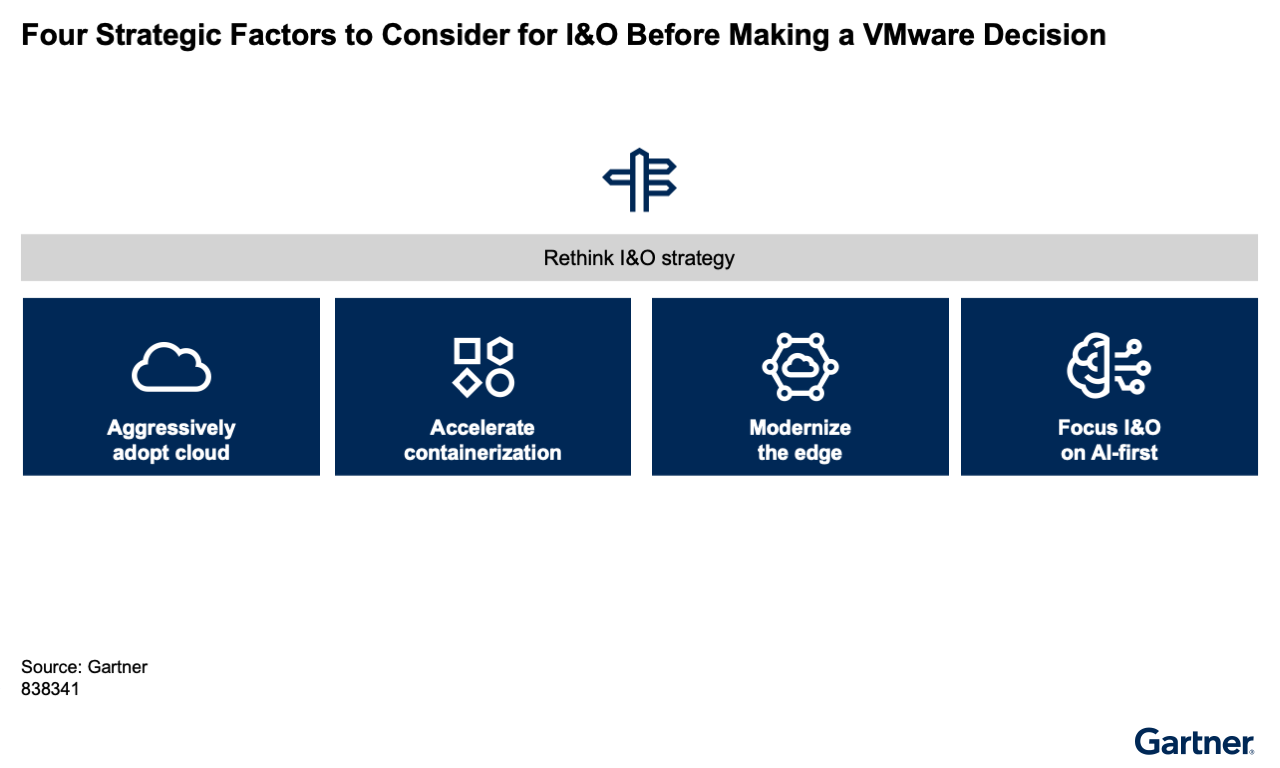
There are at least four strategic actions
(see Figure 1) that should be considered before
making any decision about VMware. Each of these
actions represent a more transformative change in
I&O and an opportunity to build the skills,
tooling and processes needed to jump-start modern
I&O practices. Doing one (or more) of these
should guide your stay-vs.-switch choice and reduce
your strategic dependence on VMware:
Analysis
Figure 1. Four Strategic Factors to
Consider for I&O Before Making a VMware
Decision
Gartner 2025
Aggressively Adopt Cloud Computing
Back to top
VMware was instrumental in bringing virtualization
mainstream, but deepening reliance on VMware created
an inertia trap that kept many organizations locked
into existing on-prem deployments — even as cloud
computing began to redefine how applications were
delivered. Broadcom’s price increases have made
cloud computing options more financially appealing
due to the following factors:
-
The cost of rearchitecting an application
to be cloud-native has slowed cloud adoption
but now it might be money well spent rather
than continuing to pay higher VMware
subscription fees.
-
While lifting-and-shifting applications to
the cloud, without change, has been costly
in the past, recent VMware price hikes have
changed that equation, making lift-and-shift
comparable to VMware on-prem in terms of
overall cost.
-
-
Lift-and-shift, lift-and-optimize and
VMware as a service options (e.g., Azure
VMware Solution, Google Cloud VMware Engine)
are also viable interim solutions that can
provide enough time to rearchitect an
application to be fully cloud-native.
-
If an on-premises footprint is required,
the distributed cloud offerings are maturing
(e.g., AWS Outposts, Azure Local).
Whether it is led by enterprise architecture or
I&O, the organizations should collaborate to
create a cloud center of excellence (CCOE) as a
starting point (see Ignition Guide to Building a Cloud Center of
Excellence). The CCOE can aggressively determine best
placement decisions for applications, and migration
paths.
Applications ideal for public cloud include:
-
Workloads
exhibit unpredictable demand spikes (e.g.,
seasonal traffic, analytics bursts)
-
Greenfield,
dev/test or pilot environments require rapid
provisioning and teardown
-
Workloads
require a global reach.
Avoid public cloud migration for applications that
have:
Keep In Mind
Early adopters of cloud who viewed it
primarily as a cost-cutting measure
frequently encountered rampant resource
sprawl and realized they were no less
locked into escalating opex than they
had been in capex. In the absence of
adequate skills, tools and governance,
the only recourse was to pour additional
money into ad hoc rescue efforts. CCOE’s
can provide the guidance, the governance
and best practices to make a cloud
migration efficient and effective.
Related Research:
Accelerate Containerization
In a VMware-centric set up, virtual machines are
the standard unit of deployment and management. But new applications require a cloud-native
infrastructure leveraging containers and
Kubernetes
for more agile development and scaling. For example,
AI workloads naturally decompose into microservices
— feature extraction, model serving, batch training
— and container ecosystems have reached production
readiness with robust security and enterprise
support. Enabling containers
can help I&O create consistent, reproducible
environments from development through production,
scale individual AI services on demand and integrate
tightly with CI/CD pipelines to iterate models
rapidly and safely. The shift does require
upskilling DevOps teams to master Kubernetes,
networking policies and cluster security, as well as
investing in new monitoring, logging and governance
tools to manage the complexity of distributed
microservices.
This is most suitable when:
-
The development team
is building new container-based applications
or refactoring existing applications, and
needs I&O support.
-
Organizations must support
on-prem, public cloud and edge deployments
using consistent tools and processes.
-
I&O needs to scale
AI components (e.g., separate services for
feature extraction, model scoring, data
preprocessing).
However, a lack of Kubernetes and DevOps expertise
— along with insufficient security and governance
processes to operate at the granularity that
containers demand — can become significant
roadblocks. Small environments running only
monolithic applications often find that containers
introduce operational complexity without delivering
proportional speed or scalability gains.
Related Research:
Modernize Distributed Sites to Edge Computing
Back to top
Many I&O organizations manage distributed or
remote office, branch office (ROBO) sites using
VMware. Usually they support branch office
applications or closed-loop workloads
(e.g., operational technology [OT] in factories,
kiosks in stores). Requirements at the distributed
sites are typically basic, running fairly
predictable and stable workloads in virtual
machines. However, these distributed sites are evolving to add more
IoT devices, produce more local data and need more local
processing. Workloads related to IoT and local data
processing will rapidly grow. In addition, demand
for more agile workloads and inference models are
changing the nature of distributed deployments to be
more flexible without requiring on-site IT staff.
Edge AI is accelerating the demand (and opportunity)
for edge processing as a part of a distributed
computing architecture with back-end data centers or
cloud (see 2025 Strategic Roadmap for Edge Computing). These workloads are driving more IT capabilities into the OT
world, and in many cases, OT and line-of-business
organizations are going around I&O and deploying
net-new custom solutions.
The future of the branch office server is to
continue to offer branch office applications and
services but will increasingly be handling a growing
amount of edge processing relating to IoT and edge
AI.
A market has emerged for edge computing platforms
(see Market Guide for Edge Computing Platforms) that support virtual machines and containers, but
in zero-touch edge devices. Even Broadcom acknowledges the need for a new
approach for edge locations, including its VMware Edge Compute Stack and the
VMware Edge Cloud Orchestrator.
Edge computing platforms are for the edge what
VMware was for the data center.
This is most suitable when:
-
There’s opportunity to improve
existing operational technologies and/or
add IoT
-
Interactions take place at the edge between
people and/or things that are already
digital or can be improved with digital
processing
-
Edge data is growing
and it’s better to put compute near the data
than send it to a data center
-
AI can be used to automate,
enhance a process or create new business
value at the edge
-
There’s a need for
near-real-time response at the edge for
current or future workloads
-
The edge needs
to tolerate temporary disconnection (not
permanent disconnection)
Strategically, however, Broadcom is laser-focused
on customers with large data centers who need rich
data center virtualization and automation
capabilities. This is not the edge. Rather than remaining with VMware, or replacing it
with a like-for-like alternative, this disruption
can be used to investigate edge computing platforms
to replace and extend what VMware can do. This
approach also strategically enables AI, containers
and centralized management appropriate for a large
number of edge locations (see 5 Things I&O Should Do Now for Edge
Computing).
Heads of I&O using VMware for distributed sites
should:
-
Use
ROBO modernization to get I&O more
proactively engaged and leading edge
computing for the enterprise.
-
Work
with the LOB to understand current and
future edge
application requirements with the goal of
deploying a platform that enables
extensibility.
-
Evaluate
edge computing platform offerings as
nontraditional alternatives to traditional
VMware, evaluating their ability to run
existing workloads in addition to new,
potential workloads.
Related Research:
Change Your I&O Focus to AI-First
Back to top
AI is rapidly evolving and will be critical to
future I&O organizations. AI is not simply a
tool to add to I&O’s toolkit; it has the
potential to change I&O’s operational model and
strategic importance to the enterprise. Because of
the significant changes in I&O that AI will
bring, ignoring AI or investing incrementally won’t
work. The VMware disruption offers an opportunity to
look beyond, to change the I&O vision and to prioritize investments in AI over increased
investments in traditional I&O management and
automation tools (see AIFRST: An AI-First Framework for Heads of
I&O).
This is most suitable when:
Heads of I&O focused on use of AI in I&O should:
-
Invest
in the needed people, process and technology
capabilities to speed AI delivery and
optimize the human-to-machine
experience.
-
Implement
adaptive governance mechanisms that can
co-evolve with the rate of AI technology
change and facilitate experimentation.
-
Establish
an AI-oriented learning culture that starts
from the top and emphasizes
cross-I&O-organization AI mastery.
This research is drawn from previous
Gartner research, and conversations
between Gartner advisors and
clients.
2025 Gartner External Pressures
That Cascade to I&O Survey. This
survey was conducted online from 22
April through 23 May 2025 to explore
the scope and nature of external
pressures that cascade down to the
I&O function and to examine how
I&O leaders are addressing these
challenges. In total, 69 I&O and
IT leaders participated. Seventeen
were from Gartner’s Research Circle
(a Gartner-managed panel), and 52
additional responses were from
Gartner Peer Community. Respondents
from North America (n = 31), EMEA (n
= 25), Latin America (n = 2) and
Asia/Pacific (n = 11). Qualifying
respondents either led,
participated/influenced or had
visibility into the strategies and
investments pertaining to the
I&O function. All participants
were at the director level or above.
Disclaimer: The results of this
survey do not represent global
findings or the market as a whole,
but reflect the sentiments of the
respondents and companies
surveyed.
